How Do I Get AI Search Engines to Mention and Cite My Brand?
We watched 69% of our AI search impressions disappear over thirteen days, found the cause, and got them back in two weeks. Here is the whole thing — the chart, the diagnosis, the fix, and the checklist we now run.
TL;DR
An AI engine cites you when four conditions are true at once: it can reach your page, it can lift a 40–60 word self-contained answer out of it, it can resolve your brand as a specific entity, and it sees independent sources agree with you. Fix those in that order.
- Let the retrieval bots in. Allow OAI-SearchBot, Claude-SearchBot and PerplexityBot in robots.txt — and check your CDN or WAF separately, because it runs before robots.txt and overrides it.
- Answer in the first 40–60 words of every page, in a sentence that still makes sense quoted on its own.
- Make every H2 a real question and answer it in the first sentence underneath.
- Say the same thing everywhere — your site, LinkedIn, Crunchbase, G2, Wikidata. Conflicting facts get the claim dropped entirely.
- Earn third-party consensus on the specific domains your category's AI answers already cite. This is the biggest lever and the slowest one.
- Instrument it with a fixed prompt library, so a drop shows up in days rather than at the next monthly review.
Expect Perplexity to respond in days, ChatGPT and Google AI Overviews in four to eight weeks. If you are recovering from a technical break rather than building from zero, it is much faster — ours came back in three days.
The drop: 330 impressions a day to 103, and nobody noticed for a week
This is our Google Search Console Generative AI features report for the 28 days to 13 September. It is the only first-party window any of us get into AI search visibility, and it is the chart that started this whole project.
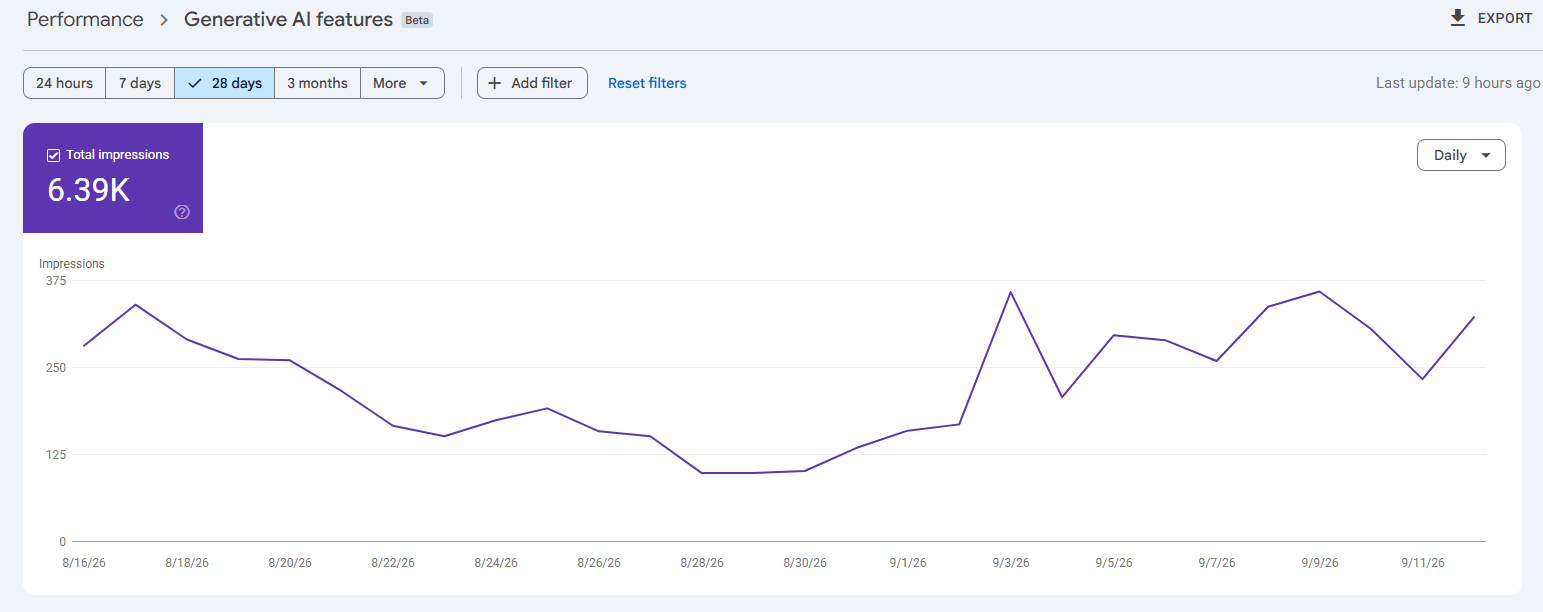 Search Console → Performance → Generative AI features, 28-day view. Peak of ~330 daily impressions on 17 August, floor of ~103 on 29–31 August, recovery spike to ~358 on 3 September. 6.39K impressions total.
Read left to right. We were sitting comfortably around 280–330 impressions a day in mid-August. From 18 August the line starts walking downhill — not a cliff, a slope. By 22 August we were at 190. By 29 August we bottomed out near 103 and stayed flat there for three days.
That is a 69% loss of AI visibility, and the shape of it is exactly why we missed it. A cliff triggers alarms. A slope looks like seasonality. Late August, people are on holiday, traffic is soft everywhere — we told ourselves that story for about six days before someone asked why organic clicks had not softened by anything like the same proportion.
That was the tell. Classic blue-link impressions were down about 8% over the same window, which genuinely was seasonal. AI impressions were down 69%. Two numbers that normally move together had decoupled, which meant something specific to the AI surface had broken.
What actually broke
On 18 August we shipped a redesigned article template. It looked better. It also did three things we did not think about:
It moved the answer below a lazy-loaded component. The new design opened with a "Key takeaways" card that rendered client-side. In the server HTML, the first thing after the H1 was an empty div. The paragraph that actually answered the page's question had been pushed down and, for anything reading raw HTML, effectively buried. Passage-level retrieval scores chunks, not pages, and a disproportionate share of citations come from the opening stretch of a document. We had emptied ours.
It turned our FAQs into client-fetched accordions. Previously the FAQ answers sat in the HTML and were hidden with CSS. The new component fetched them on click. A human clicking sees the same thing. A crawler sees an accordion full of nothing. Our FAQ blocks had been quietly earning a meaningful share of our citations, and they went dark.
It added a redirect hop. The redesign came with a path change from /blog/ to /resources/. Our older URLs already had one legacy redirect on them, so the new rule stacked a second hop on top, and a handful of syndicated inbound links made it three. Googlebot tolerates long chains without complaint. AI retrieval crawlers are far stricter — they abandon at around three hops and, critically, they fail silently. No error, no report, no line in Search Console. The page simply stops being eligible.
None of these were content problems. Every page was as good on 29 August as it had been on 17 August. We had just made all of them unreadable to machines, in three separate ways, in a single release.
The gradual slope makes sense once you know the cause: the decline tracked Google's recrawl of our library. Pages dropped out as they were re-fetched, one batch at a time, over about thirteen days. That is what a template regression looks like on a chart, and it is worth committing to memory — a slow, even decay across an entire site usually means something structural, not something editorial.
What we changed, and how fast it came back
We shipped the fix on 1 September. Three changes, all boring:
- Server-rendered the opening answer paragraph so it sits in the raw HTML immediately after the H1, in a self-contained sentence that reads correctly if you quote it alone.
- Moved FAQ answers back into the HTML, hidden with CSS rather than fetched on interaction.
- Collapsed every redirect chain to a single hop and repointed the legacy rules directly at final URLs.
First movement showed up on 3 September: a spike to around 358 impressions, higher than the pre-drop peak. That is not magic, it is recrawl — a batch of pages came back eligible at once. It settled back to 205 the next day, then climbed and stabilised in a 250–350 band for the rest of the month, with the usual weekday sawtooth.
Three days from fix to first signal. Roughly two weeks to a stable band. That timeline is specific to recovering something you already had: the authority and the third-party consensus were untouched, so once the mechanical blockers cleared, our old position came straight back. Building that position from zero is a four-to-eight-week job on ChatGPT and Google, faster on Perplexity, which weights recency heavily and refreshes its index aggressively.
Why this happens to good sites constantly
The uncomfortable finding underneath all of this is that AI citation and Google ranking have come apart. Ahrefs measured that in July 2025, 76% of pages cited in AI Overviews also ranked in Google's top 10 for the same query. By February 2026 that figure had fallen to 38%. BrightEdge's separate analysis put the overlap lower still, around 17%.
Two things follow. Your rankings no longer protect you — we held our positions throughout the drop and it made no difference. And your competitors' rankings no longer block you, which is the good news for anyone starting from a weak domain.
It also means each engine has to be treated separately, because they do not share an index. ChatGPT leans heavily on third-party directories and review sites; Profound's citation analysis found directories accounting for roughly 48.7% of its citations. Perplexity leans on community and recency — the same analysis found Reddit making up about 46.7% of its most-cited sources. Google AI Overviews and AI Mode run on Google's own index. You can be highly visible in one and completely absent from another, and only find out if you check each one.
The checklist
This is what we run now, quarterly on the whole site and before every template release. It is ordered deliberately: Parts 1 and 2 are where sudden losses come from and they are cheap to fix, Parts 3 to 6 are where durable position comes from and they are not.
Part 1 — Access: can the machines reach you?
- robots.txt explicitly allows retrieval bots: OAI-SearchBot, ChatGPT-User, Claude-SearchBot, Claude-User, PerplexityBot, Perplexity-User.
- You have made a deliberate, documented decision on training crawlers (GPTBot, ClaudeBot, CCBot, Google-Extended) — separately from the retrieval ones. Blocking training is a legitimate choice; blocking retrieval removes you from AI answers entirely.
- Deprecated agents (anthropic-ai, Claude-Web) removed so the file is not carrying dead instructions.
- Your CDN, WAF or bot-management layer is not challenging AI retrieval bots. Check this separately — it runs before robots.txt and overrides it. Aggressive default bot-fight settings are the single most common cause of invisible AI blocking.
- Server logs confirm the bots arrive and get 200s, verified by reverse DNS rather than trusting the user-agent string.
- Redirect chains are one hop maximum.
- Primary answer content is in the server-rendered HTML, not injected client-side.
- Tab and accordion content is present in the raw HTML, not fetched on click.
- sitemap.xml current, referenced in robots.txt, returning 200.
Part 2 — Extraction: can one clean passage be lifted?
- Every page answers its core question in the first 40 to 60 words, in a complete sentence that survives being quoted alone.
- That opening answer does not depend on the headline, an image or a previous paragraph to make sense.
- Each H2 is phrased as a question a buyer would actually type or say.
- The first sentence under each H2 directly answers that H2.
- Paragraphs run 40 to 80 words.
- Numbers, dates and prices appear as HTML text, not only inside images.
- Comparisons use real tables with proper headers; lists use real list markup.
- Marketing hedges removed. "Arguably one of the leading solutions" cannot be cited. "Cuts onboarding from 14 days to 3" can.
- One page per distinct question, rather than five answers buried in a mega-guide.
Part 3 — Entity clarity: does the machine know who you are?
- Organization schema with legal name, logo, founding date and sameAs links.
- Article schema with a named author; Person schema with real credentials.
- FAQPage schema only where visible FAQ content actually exists.
- Brand name, one-line description and category stated identically across your site, LinkedIn, Crunchbase, G2, Capterra and any Wikipedia or Wikidata entry.
- Pricing and feature names match everywhere. Conflicting facts across sources cause models to drop the claim rather than pick a side.
- Clean, query-matched slugs.
Part 4 — Consensus: what do other sources say about you?
- You have run your priority prompts and logged which domains get cited. That list is your real target list — not a generic outreach list.
- G2 and Capterra profiles complete, claimed and recently reviewed.
- Presence in the roundups and "best X" listicles that already appear in your category's AI answers.
- Genuine participation in relevant community threads. Not astroturfing — models and moderators both catch it.
- Original data or benchmarks that give other people a reason to cite you.
- Named expert commentary in the five to ten publications that dominate your category's answers.
- A documented process for correcting factual errors AI engines repeat about you: publish the correction on a source they already cite, then re-check the prompt in two to four weeks.
Part 5 — Freshness: are you still true today?
- Visible "last updated" date matching dateModified in schema.
- Priority pages reviewed on a fixed calendar.
- Updates are substantive. Bumping a date without changing content is detectable and does not work.
- Any statistic older than 18 months re-verified or replaced.
Part 6 — Measurement: would you notice a drop in 48 hours?
- A fixed library of 30 to 50 buyer-intent prompts, written down and version-controlled.
- Those prompts run on a cadence across ChatGPT, Perplexity, Gemini, Claude, Copilot and Google AI Mode — each has its own index, so each needs its own measurement.
- Search Console → Performance → Generative AI features checked weekly, and compared against your blue-link trend. The gap between them is the early warning.
- Referral traffic segmented by AI source in analytics.
- Server-log monitoring of AI bot hits, with an alert if crawl volume drops sharply. This is the check that would have caught ours on day two.
- Mentions and citations tracked separately — being recommended without a link is a different problem from being linked without a recommendation.
Take the full checklist with you
All 48 checks, printable, with the extra items we cut from this post for length — CDN configuration, Pay Per Crawl settings, canonical hygiene and the full measurement cadence. No email required.
Download the AI Citation Checklist (PDF)
3 pages · A4 · print-ready · updated September 2026
How long should this take?
| Situation | First signal | Stable result |
|---|---|---|
| Recovering from a technical block you have now fixed | 2–5 days | ~2 weeks |
| Restructuring existing pages that already have authority | 2–3 weeks | 4–6 weeks |
| Building visibility on Perplexity from zero | Days to 2 weeks | 4–6 weeks |
| Building visibility on ChatGPT or Google AI Overviews from zero | 4–8 weeks | 3–6 months |
| Shifting third-party consensus in a competitive category | 2–3 months | 6–12 months |
Frequently asked questions
Why doesn't ChatGPT mention my brand even though I rank #1 on Google?
Because ranking and citation have decoupled. Ahrefs found the share of AI Overview citations coming from top-10 results fell from 76% in July 2025 to 38% by February 2026, and ChatGPT does not use Google's index at all. Ranking gets you found by people searching; citation requires a liftable passage, a resolvable entity and third-party agreement. A #1 page written as 1,500 words of narrative with no extractable answer will lose citations to a clearly-structured page ranking eighth.
How long does it take to get cited by AI search engines?
Perplexity is fastest, often days to two weeks, because it weights freshness heavily. ChatGPT and Google AI Overviews typically take four to eight weeks, since both lean on established authority signals that take time to accumulate. If you are fixing a technical block rather than building from scratch, recovery is much faster — ours showed first movement in three days and stabilised in two weeks.
Why did my AI Overview impressions suddenly drop?
Check technical causes before content causes. In order of likelihood: a CDN or bot-management rule that started challenging AI crawlers, a robots.txt change, a site migration that introduced redirect chains, or a template change that moved key content behind client-side rendering. A sharp overnight cliff usually means access. A gradual even slope over one to three weeks usually means a template or structural regression rolling out as pages get recrawled.
Does blocking GPTBot stop ChatGPT from citing my website?
No — but blocking OAI-SearchBot does. OpenAI separates its crawlers: GPTBot gathers training data, while OAI-SearchBot and ChatGPT-User handle search indexing and live retrieval. You can block GPTBot to keep your content out of model training while staying fully eligible for citation. The same split applies to Anthropic (ClaudeBot for training, Claude-SearchBot and Claude-User for retrieval). Many sites block everything by accident and remove themselves from AI search without realising it.
Do I need an llms.txt file to get cited by AI?
No. It is a proposed convention rather than a standard that major engines commit to honouring, and no engine currently requires it. It is cheap to add and may help agents navigate to your best pages, so there is little reason not to — but it is a nice-to-have, not a fix. If it is served from anywhere other than your domain root with a 200 response, it is ignored entirely. Spend the effort on Parts 1 and 2 of the checklist first.
Why does Perplexity cite Reddit instead of my website?
Because Perplexity weights community discussion and recency very heavily — Profound's analysis found Reddit accounting for roughly 46.7% of its most-cited sources. The practical response is not to fight it but to be present in it: participate genuinely in the threads where your category is discussed, and make sure that when someone does mention you there, what they say matches what your site says. You often get the recommendation even when a third-party page gets the link.
Can I pay to get my brand mentioned in ChatGPT answers?
Not directly, and anyone selling guaranteed placement in organic AI answers is selling something they cannot deliver. What you can pay for is the work: content restructuring, PR placement on the domains that already get cited, review-site presence, and monitoring tooling. Advertising products inside AI interfaces are a separate, clearly-labelled surface — they do not influence which sources get cited in an organic answer.
Does schema markup help AI search engines cite my brand?
It helps with entity resolution more than with citation directly. Schema tells an engine unambiguously what your organisation is, who wrote a page, and what a product costs, which makes you easier to identify confidently as the right entity to mention. It will not rescue a page that has no extractable answer in it. Treat schema as a clarity layer on top of good structure, not a substitute for it.
What's the difference between being mentioned and being cited by AI?
A mention is the engine naming your brand in its answer. A citation is a linked source attribution. They come apart constantly: an answer may recommend your product while linking to a G2 profile or a Reddit thread as the source. Mentions drive consideration and brand recall; citations drive referral traffic. They have different causes and different fixes, so track them as two separate metrics.
How do I get cited by AI if my domain authority is low?
This is the best argument for doing the work now. Because citation has decoupled from ranking, high-authority competitors no longer crowd you out the way they do in blue links. Target specific, lower-competition prompts rather than head terms; publish original data nobody else has; make sure your pages are the single most extractable answer to a narrow question; and get listed on the third-party domains your category's answers already cite. Small brands with genuinely better-structured content regularly beat larger ones here.
How many sources does an AI answer actually cite?
Typically between two and seven, which is the real scarcity problem. There is no page two. Being the eleventh-best source for a query is worth nothing, so it is usually better to be unambiguously the best answer to fifty narrow questions than a mediocre answer to five broad ones.
Is GEO just SEO with a new name?
It shares the technical foundation, and good SEO remains a prerequisite. What is genuinely different is the unit of optimisation: Google ranks pages, AI engines retrieve passages. That changes how you write, where you put the answer, and what counts as success. The two disciplines used to overlap almost entirely and now overlap partially — our own drop is a small case study in that, since our rankings were completely stable throughout a 69% loss of AI visibility.
Figures cited: Ahrefs (AI Overview / top-10 citation overlap, 2025–2026), BrightEdge (independent overlap analysis), Profound (citation source distribution across ChatGPT and Perplexity). Impression data is our own, from Google Search Console, 16 August – 13 September 2026.
 Shraddha