
- What "Citation Laundering" Actually Means
- The Case That Made This Undeniable
- This Isn't a One-Off. It's a Measurable Pattern.
- When the Stakes Aren't Pizza: Health Search
- The CTR Collapse Is the Other Half of This Story
- So Why Does This Keep Happening?
- What Reddit's Own Users Think About Becoming the Internet's Source of Truth
- What This Means If You're Building a Brand Right Now
- Where We Land on This
Emerging Trends & Insights
Citation Laundering: How AI Search Quietly Turns Reddit Jokes Into "Facts"
By Shraddha
published August 31, 2026 | Updated September 2026
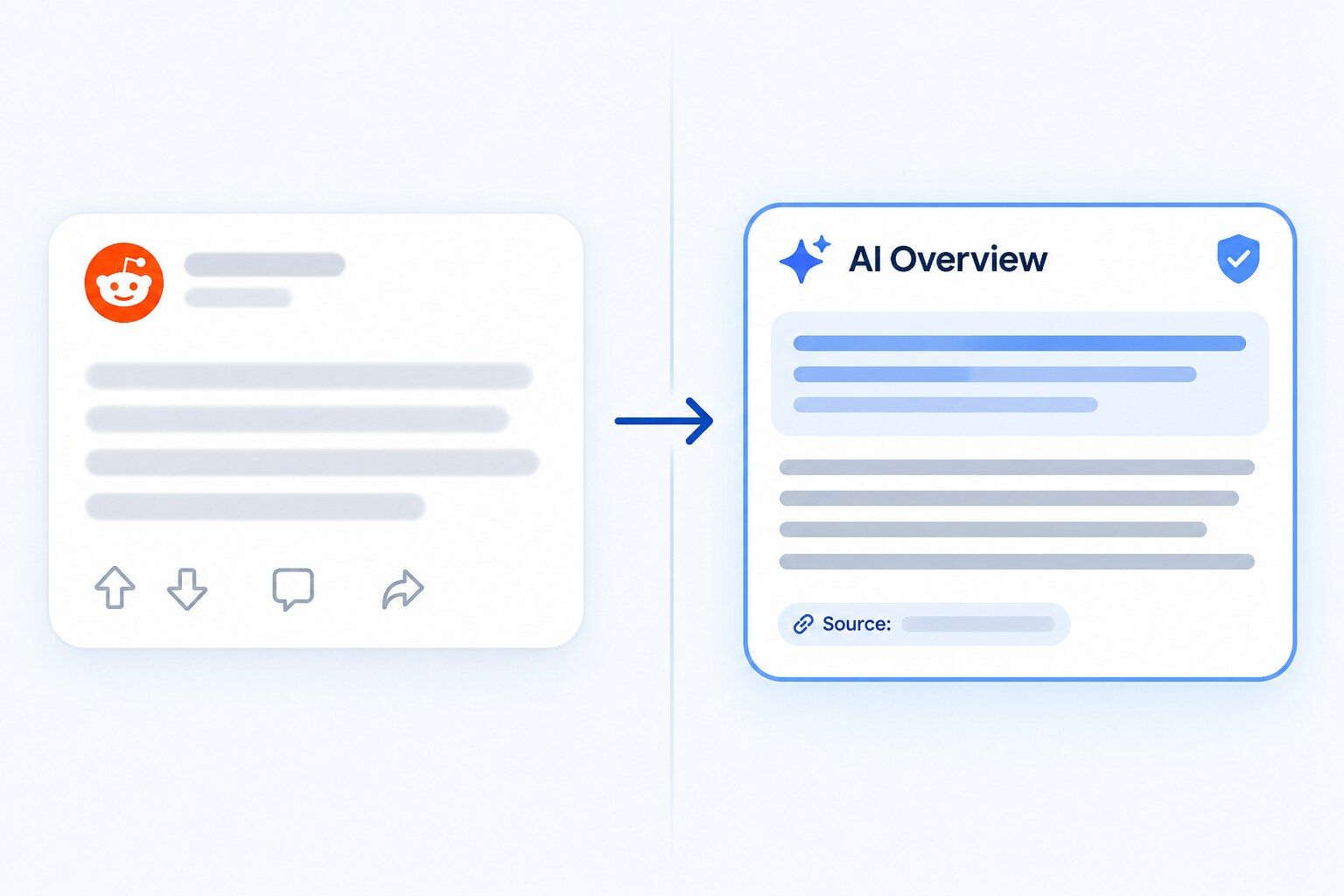
A few weeks ago, our team at Lean Summits was pulling together a client's AI search audit, and we ran a routine query through Google's AI Overviews to see how it summarized a technical topic in our client's industry. The answer sounded confident. Polished, even. Then we clicked through to the cited source, and it was a three-year-old forum comment from someone with zero credentials, sitting at eleven upvotes. Not a study. Not an industry publication. A comment.
We sat there for a minute just staring at it. Not because it was shocking, anyone who's spent time in generative engine optimization this year has seen some version of this, but because it crystallized something we'd been circling for months: AI search isn't just citing sources anymore. It's laundering them. It takes something obscure, unverified, or outright accidental, wraps it in the tone of an encyclopedia entry, and hands it to a user as settled fact. We started calling this pattern citation laundering, and once you see it, you can't unsee it.
This piece is our attempt to actually document what's going on, with data, with real incidents, with what experts and publishers are saying, and with what it means if you're trying to build a brand that AI engines can trust enough to cite accurately.
What "Citation Laundering" Actually Means
Citation laundering is what happens when an AI system takes a low-authority, unverified, or informal source, a forum post, an outdated comment, a stray blog, and re-presents it with the confident, neutral tone of an authoritative answer. The original source's shakiness disappears in translation. The user never sees "this came from a joke someone posted in 2013." They just see an answer, formatted like a fact, sitting above the search results.
It's a distinct problem from the one most GEO guides talk about. Most of the advice out there is about how to get cited, structure your content, answer the question in the first 100 words, add FAQ blocks. That's necessary. But it sidesteps a harder question: what happens when the citation itself is bad? Getting cited doesn't mean getting believed correctly, and being accurate doesn't guarantee you're the one who gets cited.
The Case That Made This Undeniable
The clearest illustration is still the "glue on pizza" incident, and it's worth revisiting because the mechanics haven't changed, only the stakes have gotten higher. When Google's AI Overviews launched broadly in 2024, a user searched for why cheese slides off pizza. The AI confidently suggested mixing in "about 1/8 cup of non-toxic glue" for tackiness.
"🍕 Google's AI Overview recommending glue in pizza sauce, screenshotted and shared to X as the moment "AI search" went mainstream-viral for all the wrong reasons."
Internet sleuths traced the recommendation back to its source, and it wasn't a food scientist or a culinary site. It was an 11-year-old Reddit comment, posted by a user with a vulgar handle, in a thread about cheese sliding off pizza, with eight upvotes at the time.
"Security researcher Kurt Opsahl traced the AI's "conclusion" directly back to that decade-old joke comment, screenshotting the source thread for comparison."
That's citation laundering in its purest form: an offhand joke, dressed up as culinary science, delivered to millions of people as an authoritative answer. Google's response at the time downplayed the incident. A company spokesperson said "the vast majority of AI Overviews provide high quality information, with links" back to the source, technically true, and beside the point, since the whole issue is what happens in the minority of cases where it isn't.
This Isn't a One-Off. It's a Measurable Pattern.
What makes this genuinely worth writing about in 2026 isn't the pizza meme, it's that researchers have since quantified how often this kind of thing happens, at scale, across every major AI engine.
- Citations rarely match rankings. An analysis by Surfer found that 67.82% of sources cited in Google's AI Overviews don't appear anywhere in the top 10 organic results for the same query, meaning the AI is very often reaching past the pages Google's own ranking systems consider most authoritative.
- News citation accuracy is genuinely bad. A Tow Center for Digital Journalism study at Columbia tested eight major AI search products on their ability to cite news accurately. Collectively, they were wrong more than 60% of the time, and rarely flagged their own uncertainty when they were.
- Reddit is now the single most-cited source across AI engines. A Semrush-based analysis of 150,000 citations across ChatGPT, Perplexity, AI Overviews, and Google AI Mode found Reddit accounted for 40.1% of citations, ahead of Wikipedia, YouTube, and Google itself, a shift that traces back to a $60 million data-licensing deal Google signed with Reddit in 2024.
- AI-generated spam is now citing itself. Reporting based on analysis from AI-detection company GPTZero found Perplexity increasingly citing sources that were themselves AI-generated, including outdated or incorrect information laundered through a layer of synthetic content before it ever reached the user.
The pattern across all of this: these systems are optimizing for extractable, confidently-phrased text, not for verified authority. A forum comment written in a clean, declarative sentence can out-compete a hedged, nuanced paragraph from a genuine expert, because the model isn't grading credentials, it's grading extractability.
When the Stakes Aren't Pizza: Health Search
The pizza story is funny because the worst outcome was a ruined dinner. It stops being funny in categories where bad citations have real consequences, and health search is the clearest example.
SE Ranking analyzed 50,807 German-language health queries and found AI Overviews now appear on over 82% of health-related searches. Within those answers, YouTube was the single most-cited source, cited more often than hospitals, government health agencies, or academic institutions, despite ranking only 11th in organic visibility for the same queries. Roughly two-thirds of the citations came from sources without strong medical or evidence-based safeguards, and only 36% of cited pages even appeared in the top 10 organic results.
The independent patient-safety group ECRI has since named AI chatbot misuse a top health-technology hazard for 2026, a direct response to exactly this dynamic: systems that present unverified information with the same confident tone as peer-reviewed medical guidance. This is the sharpest version of citation laundering there is. A casual explainer video and a clinical review paper get flattened into the same authoritative-sounding paragraph, and the user has no way to tell which one they actually got.
"Users are reading the overview and stopping there. We see it.", testimony from Penske Media executives, cited in the company's antitrust filing against Google over AI Overviews.
That quote matters beyond the legal fight it's from. It's the mechanism behind everything in this article: people are not clicking through to check the source. They're trusting the summary. Which means the summary's sourcing quality is the product now, whether or not the AI companies are treating it that way.
The CTR Collapse Is the Other Half of This Story
Citation laundering isn't just an accuracy problem, it's compounding a traffic problem that's already reshaping publishing. Ahrefs' February 2026 study of 300,000 keywords found that AI Overviews now correlate with a 58% reduction in click-through rate for top-ranking pages, nearly double the decline recorded a year earlier. Pew Research found that only 8% of users click a traditional result when an AI Overview is present, compared to 15% when it isn't.
Chartbeat's data across 2,500 publisher sites shows this pain is distributed unevenly: small publishers have seen search referral traffic fall 60%, mid-sized publishers 47%, and large publishers 22%. So the sites least equipped to fight a bad citation (small, independent, specialist publishers) are also the ones losing the most traffic to begin with. If your accurate, well-sourced page gets skipped in favor of a forum comment, you don't just lose the citation. You lose the click that would have let a real person catch the AI's mistake.
If your brand's accuracy is losing to a Reddit comment in AI search, that's fixable, but it needs a real audit, not a guess. Lean Summits runs full technical SEO and AI search audits that show you exactly what's being cited about your brand, where the gaps are, and how to close them.
So Why Does This Keep Happening?
A few structural reasons, and none of them are going away on their own:
- Extractability beats authority. Surfer's research on AI Overview citations found that cited pages score 29% higher on "fact coverage" than non-cited pages, meaning density and clarity of claims matters more to these systems than who's making them.
- Community platforms are structurally over-represented. Reddit and YouTube produce huge volumes of plainly-worded, first-person, question-and-answer content, exactly the shape these models are trained to extract from. That's great for genuine reviews and terrible when the top comment happens to be a joke.
- There's a feedback loop. As more AI-generated content fills the web, models increasingly cite pages that were themselves built on earlier AI outputs, compounding small errors instead of correcting them, generation after generation.
- Nobody's actually accountable for the citation. When an AI Overview is wrong, there's no editor, no correction, and often no easy way for the cited party to even know they were misrepresented.
None of this means AI Overviews are broken beyond use, AI is reshaping SEO strategy in ways that are genuinely useful for brands who adapt. It means the old assumption, "if I rank well, I'll get cited accurately", no longer holds, and treating GEO as a pure visibility game misses the accuracy half of the equation entirely.
What Reddit's Own Users Think About Becoming the Internet's Source of Truth
Reddit's sudden role as the most-cited domain in AI search hasn't gone unnoticed by the people posting there. Industry commentary tracking this shift has pointed out the obvious tension: Reddit's value to AI systems comes precisely from its casual, unverified, first-person tone, the same quality that makes it easy for a sarcastic answer or an outdated opinion to get "laundered" into an authoritative-sounding AI summary. The platform was never built to be a citation source, and its own community culture, sarcasm, in-jokes, deliberately bad advice as a bit, is exactly what makes it risky material for a system that can't reliably detect tone.
What This Means If You're Building a Brand Right Now
If you're doing GEO work in 2026, citation laundering changes the brief in a few concrete ways:
- Being right isn't enough, being extractable-and-right is the actual goal. Dense, clearly-structured, fact-forward content that states its claims plainly will out-compete beautifully written but hedged prose, every time, in these systems.
- You need to know what's being said about you, not just whether you're mentioned. Visibility tracking that only counts citations misses the point if some of those citations are wrong, outdated, or pulled from a source you don't control. This is core to the AI-search-readiness checklist we run with clients.
- Community platforms are now part of your SEO footprint, whether you like it or not. If Reddit and forums are shaping what AI engines say about your category, ignoring them isn't neutral: it's ceding the narrative to whoever shows up there instead.
- Zero-click doesn't mean zero-impact. Even when a laundered citation doesn't send a click, it's shaping what a potential customer believes about your product before they ever reach your site, which is exactly the dynamic we break down in zero-click searches and AI Overviews.
- Google's own quality signals still matter here. Sites hit by recent spam and quality updates are, unsurprisingly, also the ones most likely to get skipped in favor of a "cleaner"-sounding but less-credible source.
Where We Land on This
Honestly, our team goes back and forth on how alarmed to be about this. On one hand, AI search is genuinely useful, and most of the time the citations are fine. On the other, "most of the time" is doing a lot of work in an ecosystem where AI Overviews now appear on roughly half of all Google searches, and users are demonstrably not clicking through to check. When the failure mode is a ruined pizza, that's a funny story. When it's health information, financial advice, or what a potential customer believes about your company, "most of the time" isn't a great safety margin.
What we keep coming back to is this: citation laundering isn't a reason to give up on GEO. It's a reason to treat GEO as a trust problem, not just a visibility problem. The brands that win the next few years of AI search won't just be the ones who get cited most: they'll be the ones whose citations are actually worth trusting, in a landscape where that's increasingly rare.
Want to know exactly what AI engines are saying about your brand right now, and whether it's accurate? Lean Summits builds GEO strategies around real citation and accuracy audits, not just visibility counts.
 Shraddha