
AI & Automation
How AI Is Reshaping SEO Strategy in 2026: From Keywords to Predictive Content
By Shraddha
published January 13, 2026
As AI continues to evolve the world around us, traditional SEO approaches are becoming less effective. Relying solely on keywords and backlinks is no longer sufficient for effective content marketing for your brand.
This is because of a drastic shift in user behavior in how they search the internet today. AI search algorithms now account for around 33% of total organic search. This requires updating your SEO strategies to adapt to the changing landscape of algorithmic optimizations.
Over 60% of leading marketers have already started using predictive analytics to shape their strategies. As the future of SEO continues to shift from reactive optimization to a more proactive model, using predictive content has now become necessary.
As generative search optimization continues to replace traditional keyword matching, every competing marketer requires their own AI SEO strategy for 2026.
How AI Search Engines Interpret Intent
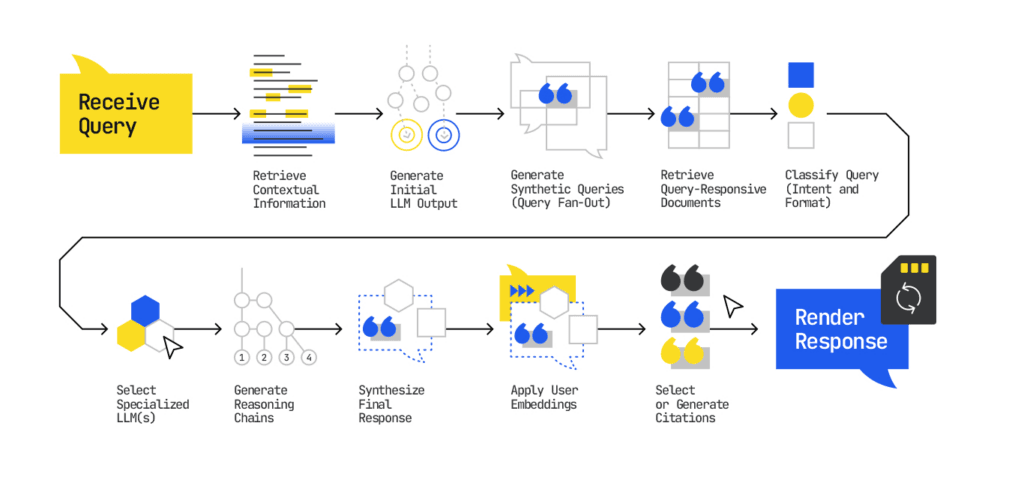
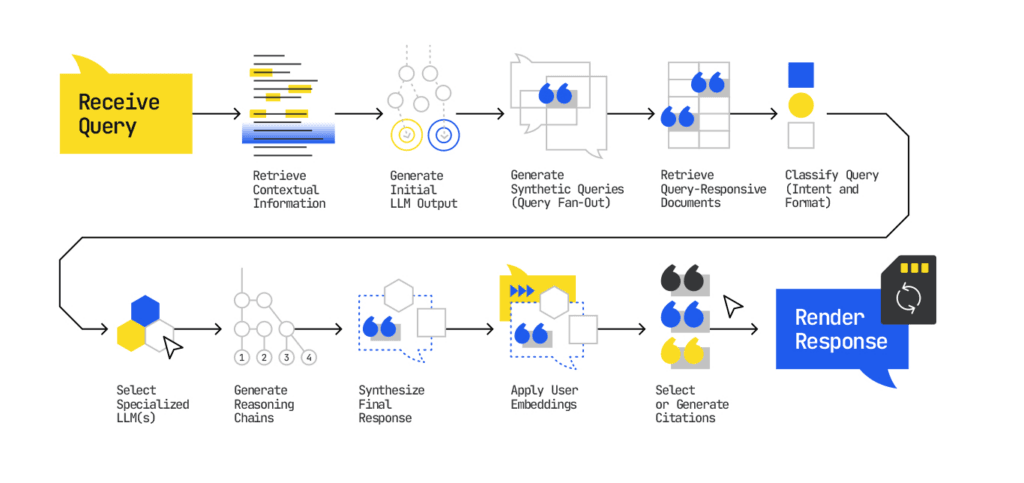
Artificial intelligence has changed the way people find information. For years, Google was the dominant search engine, handling the majority of search queries on the internet. Now, conversational AI platforms like ChatGPT and Perplexity have taken over, providing a more natural way of solving user queries.
These AI search algorithms no longer require a string of keywords to find matching results. Instead, they rely on analysing complex intent context and the semantic relationships that bridge different concepts.
For SEO discoverability today, you require content that not only resolves such search queries but also the reasoning process used by these AI models. Your ranking is no longer a position on the search page, but a citation provided within the answer itself. This requires generative search optimization, where your content is easily machine-readable, logically structured, and provides strong authority for AI visibility.
- From Keywords to Context: All AI models use Natural Language Processing (NLP) to understand queries and questions. This is why optimising your SEO content based on the topic itself has become more critical than simply matching precise keyword densities.
- Citation is the Click: Your brand visibility in AI-generated answers and your AI Presence Rate is now a critical success metric. This is because AI citations from your website or blog content can now supplement, or even surpass, traditional click-through rates.
Predictive Content and Topic Modeling
Since AI can now generate basic informational answers by itself, the new way to get results from your AI SEO strategy for 2026 is through predictive SEO. This involves analysing current search queries and anticipating future trends, creating content that answers user questions before they become mainstream.
How can you implement predictive SEO in your current strategy? It uses data analysis and AI forecasting to predict interest in emerging topics. For example, spotting a 20% increase in searches for “sustainable AI data centers” allows you to create informative content on this topic long before your competitors can compete using similar content.
The execution of this strategy heavily relies on AI topic modeling. Using advanced platforms, you can use transformer-based NLP to map the unique semantic relationships between thousands of keywords. This makes clustering them into singular topic groups to understand your user intent much easier.
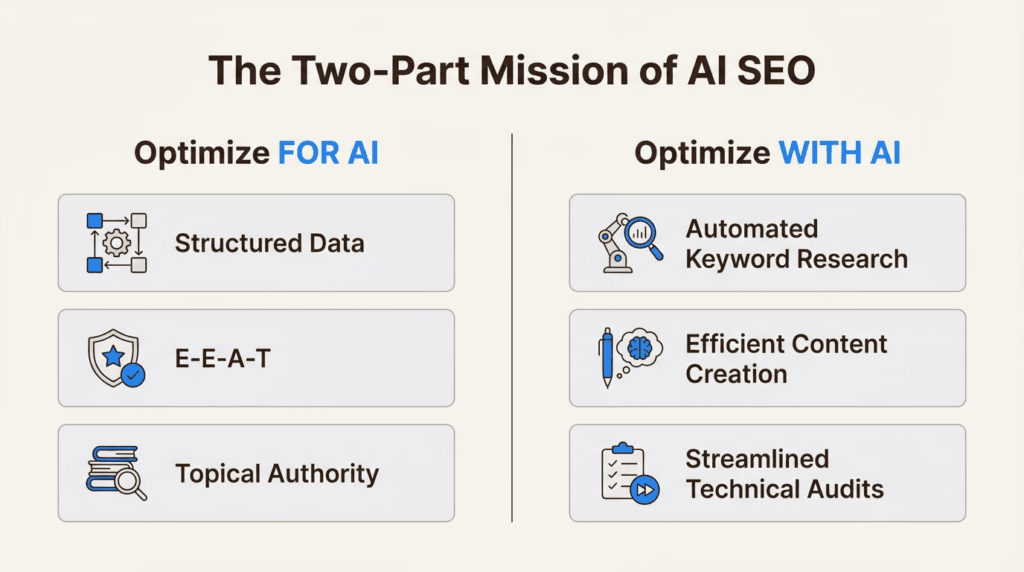
Moreover, this approach also allows you to build topical authority that goes beyond targeting isolated keywords. Using forecasting, you can create an interconnected “content ecosystem” that covers every aspect of a particular subject. This strengthens your content’s trustworthiness for an AI model seeking a reliable source on a particular topic.
New Ranking Factors in AI SERPs
Ranking signals of AI search algorithms go far beyond any traditional metrics. The future of SEO is measuring your content quality based on your technical readiness and off-site authority.
| Factor Category | Traditional SEO Signals | New AI-First Ranking Factors |
| Content & Authority | Keyword usage, backlink volume & authority | E-E-A-T (Experience, Expertise, Authoritativeness, Trustworthiness), AI citations |
| Technical | Page speed, mobile-friendliness, sitemaps | Schema markup richness, crawlability for AI agents |
| Off-Site & Brand | Referring domains, brand search volume | PR, reviews, mentions across platforms like YouTube and Reddit forums |
| User Engagement | Dwell time, bounce rate | Prompt effectiveness, multimodal content performance |
Using these new AI factors can greatly enhance your brand’s perception online. As AI algorithms are trained on large datasets, they are more likely to prioritise your source if other reputable sites reference it.
BrightEdge data shows that almost 34% of AI citations come from PR-driven coverage. This means that your generative search optimization should involve earning mentions on authoritative platforms and marketing through influencer partnerships.
How to Build AI-First SEO Workflows
Adapting to this new age of AI-based SEO requires more than just new tools. It demands a complete redesign of your current workflow, integrating AI on every stage of your SEO strategy.
- Audit for AI Readiness: Your technical audit should primarily focus on AI crawlers for a more future-ready SEO strategy. This includes ensuring that your site performs well, uses clear schema markup, and contains an llms.txt file that guides AI agents to your main content. Gartner research clearly highlights that such strategic audits are very important for optimising current tech stacks, including your SEO infrastructure.
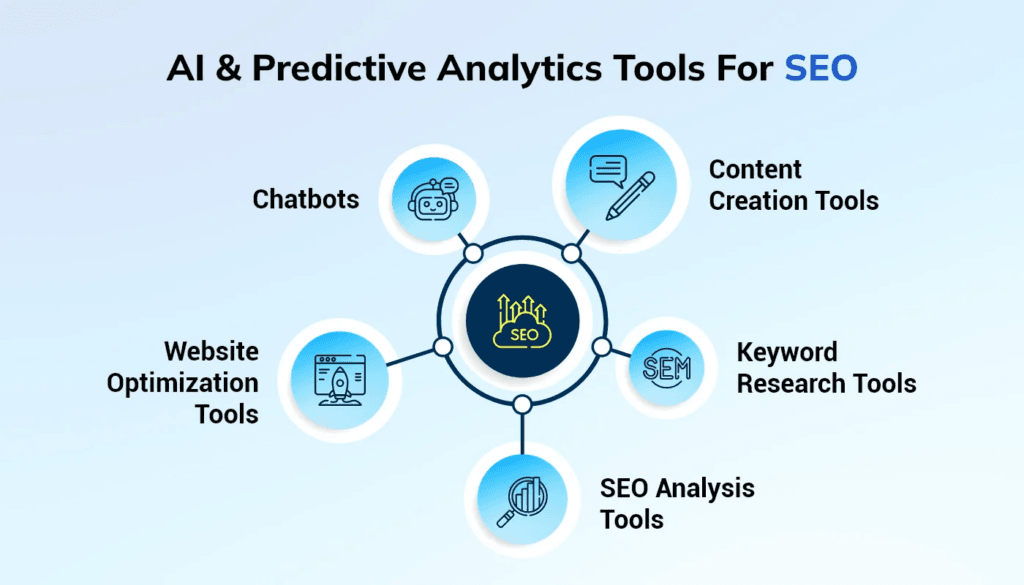
- Adopt Predictive Tools: Ensure you integrate AI SEO tools designed for predictive SEO and topic modeling for your content. Platforms like WriterZen are a great way to use transformer-based NLP to map beneficial semantic topic clusters for your content strategy. Tools like Profound are also important for tracking your brand’s visibility across AI-generated answers.
- Content for Dual Audiences: It is important that your content development strategy keeps both humans and AI in mind. Always use structured articles with clear hierarchies and concise summaries to make your content easier to extract and cite for AI models. You can also repurpose your core insights into visual formats, such as video and infographics, to drive additional multimodal search traffic.
- Measure AI-Specific Metrics: There is no point in implementing such generative search optimizations if you are not properly measuring their impact. Consider tracking your AI Presence Rate and Citation Authority to ensure your target topics are being mentioned in AI outputs.
- Cross-Functional Alignment: The future of SEO is combining your marketing strategies with PR, brand marketing, and social media influence. Such integrated strategies using earned media campaigns and influencer recommendations can significantly boost authority signals that AI search algorithms can easily recognise.
Conclusion: AI SEO Strategy for 2026
By 2026, successful AI SEO strategies will be defined by the accuracy of their predictive SEO and overall excellence earned through generative search optimization. This success will belong only to brands capable of building topical authority through deeply interconnected ecosystems.
Using advanced AI tools can transform your brand content into a trusted authority that is projected by AI across the web. Optimising your SEO now involves teaching AI systems why exactly your brand is an expert on future-ready topics.
How can you achieve this? Through flawless technical foundations and data-driven predictions that anticipate user needs and craft content for their trusted understanding. Present companies need to strike the right balance between human insight and AI-powered prediction to prepare their brand content for the next era of discoverability. Only then can your brand secure its position as a dominant player with sustained competitive advantage.
FAQs
- What is the largest shift in the future of SEO in 2026?
The most significant shift is the move from traditional keyword optimization to predictive SEO for better rankings. Instead of chasing existing search trends, future strategies will require AI to predict future trends.
This will enable the creation of authoritative content before those topics peak in popularity.
- How are AI search algorithms changing what needs to be ranked?
AI search algorithms focus on topical authority and trust over basic individual keywords. This requires your content to become a part of a deeper, interconnected ecosystem on the topic.
Only then will AI algorithms view your domain as a credible source they can cite in their generated answers.
- What is an “AI Presence Rate”? Why does it matter?
Your AI Presence Rate determines how often your brand or its content is being cited as a source in AI-generated answers. As AI responses continue to replace traditional searches, this is becoming a key metric for future SEO strategies.
- Is technical SEO still just as relevant as AI searches?
Yes, but the focus is slowly shifting. While your page speed remains an important factor, technical SEO for AI search algorithms also requires significant focus. Your site needs to be easily crawlable by AI agents to ensure AI can correctly understand and extract information from your pages.
- Can I use AI tools for executing my new AI SEO strategy?
Of course! A successful AI SEO strategy for 2026 will require the use of advanced AI SEO tools for topic modeling and trend prediction.
However, your strategy needs to be guided by human expertise. This will ensure you build genuine topical authority that AI systems can use to build trust in your brand.
 Shraddha