
AI & Automation
From Mentions to Money: How AI Visibility Actually Connects to Revenue
By Shraddha
published September 7, 2026

Every CMO and CEO we talk to eventually asks a version of the same question: "Okay, but does this actually connect to revenue?"
It's a fair question. AI visibility is a newer metric, and it can feel like a vanity number — a screenshot of your brand showing up in a ChatGPT answer, framed and hung on the wall next to a follower count. Leaders have been burned before by metrics that looked impressive in a slide deck and meant nothing in the pipeline report. So let's answer the question directly, with the same honesty we'd want if we were sitting on the other side of the table.
First, the Honest Answer: It's Not a Direct Line
AI visibility does not convert the way a paid search click converts. When someone clicks a Google ad, you can trace that session to a form fill in the same sitting. AI mentions don't work that way, for one structural reason: most AI-generated answers are zero-click by design. A person asks ChatGPT or Google's AI Mode a question, gets a synthesized answer with your brand mentioned, and often never visits your site at all in that moment. We've written about this shift in detail in zero-click searches and AI Overviews and what it means for brand recall when there's no click to measure.
So if you're looking for AI visibility to show up as a clean, same-day conversion event in Google Analytics, you'll be disappointed — and you'll conclude, wrongly, that it doesn't matter.
The Real Model: AI Mentions as a Leading Indicator
Here's the reframe that actually holds up under scrutiny: treat AI visibility the way a good CFO treats a leading indicator, not a lagging one. Website traffic, leads, and closed revenue are lagging indicators — they tell you what already happened. AI visibility is closer to a leading indicator, similar to branded search volume or share of voice: it tells you what's about to happen, a few weeks or a full sales cycle out.
The mechanism looks like this, and it's a longer path than a paid click:
- A prospect asks an AI platform a category question ("best [category] for [use case]").
- Your brand gets mentioned, cited, or recommended in that answer.
- The prospect doesn't click — but they remember the name.
- Days or weeks later, they search your brand name directly, or they land on your site through an unrelated channel already primed to trust you.
- That familiarity shows up downstream as a shorter sales cycle, a higher lead-to-opportunity rate, or a branded search spike — not as a referral session from "chatgpt.com."
This is exactly why we don't evaluate AI visibility in isolation. We track it as one input feeding a broader model, alongside the work we already do in AI-driven attribution modeling — because if you're only crediting the last click, you will systematically undercount everything AI visibility contributes.
How We Actually Track It: Data as the Working Example
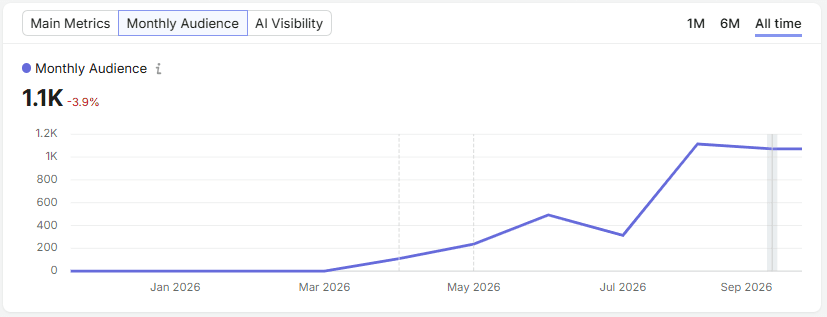This is where it stops being theoretical. Here's the exact data we look at.
We monitor brand mention frequency, citation count, and sentiment across ChatGPT, Perplexity, Gemini, and Google's AI Mode using Semrush's AI Visibility Toolkit. It gives us a 0–100 AI Visibility Score for a brand relative to its category, plus a running count of mentions and citations over time — the same kind of trend line you'd track for rankings, just for AI-generated answers instead of blue links.
The useful part isn't the score in isolation. It's what we do with it next: we lay that visibility trend line next to three other lines on the same timeline —
- Branded search volume (are more people searching the company name directly?)
- Direct and organic traffic (is total qualified traffic trending up in the same window, with a lag?)
- CRM-sourced lead volume and quality (are sales reporting more inbound leads that already "know" the brand before the first call?)
When a client's AI Visibility Score climbs for a set of high-intent category prompts, we typically see branded search and direct traffic follow within four to eight weeks, and sales-qualified lead volume shift a few weeks after that. That lag is the tell. It's exactly what you'd expect from a leading indicator, and it's a very different signal than a metric with no downstream relationship at all.
A Real Example: What This Looked Like in Practice
We've seen this play out clearly in client work. In one case, an organic traffic increase of over 12,000% for a premium auto transport company didn't happen because one AI Overview citation went viral. It happened because visibility gains compounded across traditional rankings, AI citations, and category-level prompt coverage at the same time — and the resulting lead volume let that same client reduce lead costs because more of their traffic arrived already aware of the brand, which shows up as a healthier conversion rate, not just a bigger top of funnel.
That's the pattern worth internalizing: AI visibility rarely moves revenue on its own. It moves the efficiency of everything downstream of it.
What Leaders Should Actually Ask Their Team to Track
If you're a CEO or CMO trying to hold your team accountable for this without falling for vanity metrics, ask for these four things on a recurring report, not a one-off screenshot:
- AI Visibility Score and mention trend for your top 15–20 category prompts, tracked monthly, not just once
- Branded search volume trend line over the same period (Google Search Console or your rank tracker)
- Direct + organic traffic trend, isolated from paid and social
- Lead quality signal from CRM — not just volume, but sales cycle length and close rate for leads sourced in the same window
If those four lines move together over a two-to-three month window, you have a real, defensible connection between AI visibility and revenue — not a correlation you're hoping is real. We built exactly this kind of tracking into our own technical SEO and AI search audits, and if you want to sanity-check where your own brand currently stands, our AI search readiness checklist is a good starting point before you commit budget to a bigger program.
The Bottom Line
AI visibility doesn't skip the funnel — it front-loads it. Treated as a leading indicator and measured against the right lagging metrics, it's one of the more honest signals in modern marketing, because it shows you demand forming before it shows up as a session or a form fill. Treated as a vanity number on its own, it tells you nothing, and that's usually where the skepticism from leadership comes from — not because the connection isn't real, but because it's rarely measured correctly.
If you want a second set of eyes on whether your own AI visibility is actually translating into pipeline, or you're still trying to figure out which numbers to even pull together, book a strategy call and we'll walk through your specific data with you.
Want to see how this fits into a broader growth system rather than a one-off audit? Take a look at our custom growth engine or explore what we do at Lean Summits.
 Shraddha