
Emerging Trends & Insights
Topical Gravity for Logistics: What We Found in Car Shipping
By Shraddha
published September 27, 2026
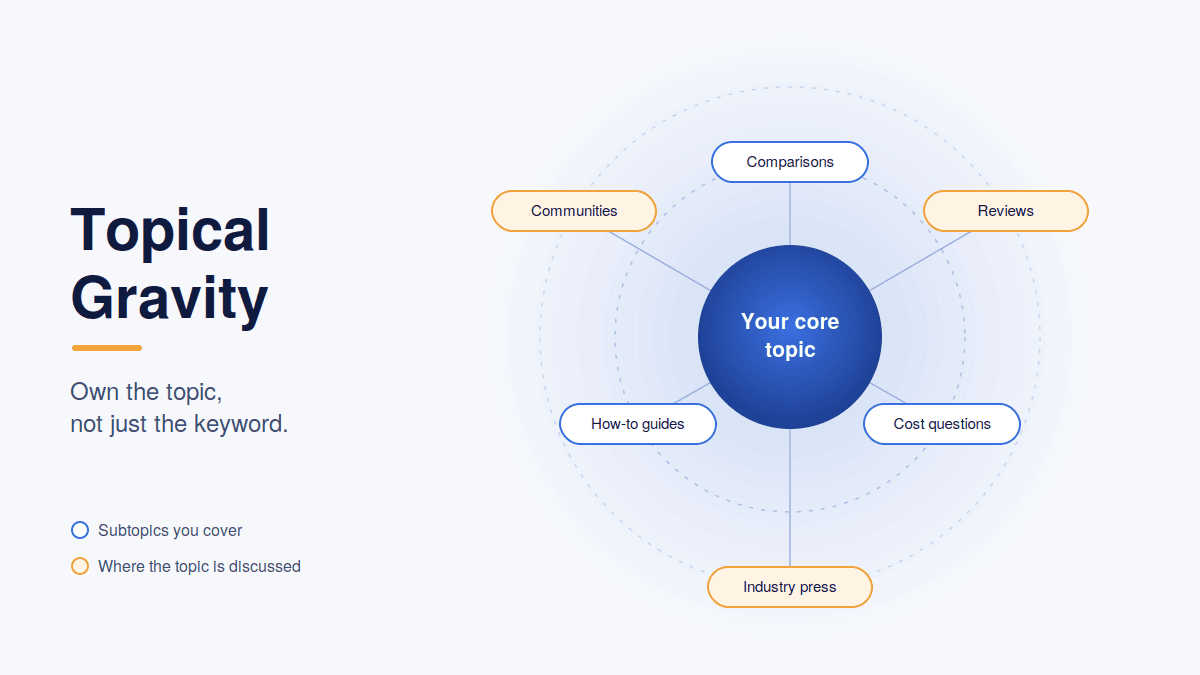
Most of our reporting for logistics clients used to start with a keyword list. Rankings up, rankings down, a few new terms added each month. That still has a place, but it no longer answers the question our clients care about most: when a buyer asks Google or ChatGPT about shipping a car, is our brand part of the answer?
Semrush recently published a framework called Topical Gravity that tackles this directly. The idea is simple. Search platforms now build answers by breaking one question into many related searches (Google calls it query fan-out), so visibility is won or lost across a whole topic, not a single keyword or prompt. We put the framework to work for one of our logistics clients, a US auto transport company, and the results changed how we plan their content.
What Topical Gravity Says
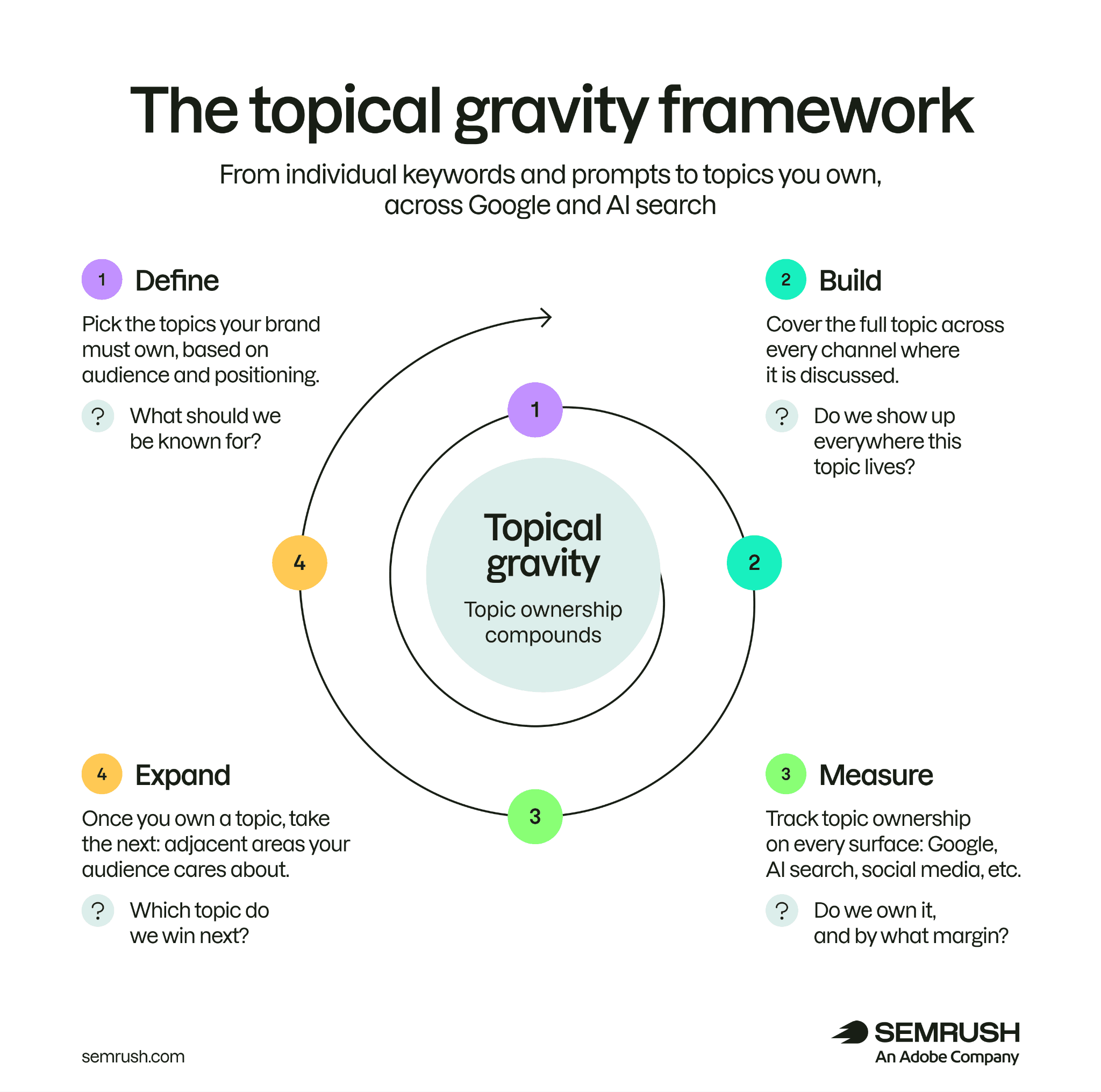
Source: Semrush
The framework runs as a loop with four stages:
- Define the topics your brand must own, based on your audience, positioning, and revenue.
- Build coverage across each topic, on your own site and in the places answer engines pull from, like review platforms, communities, and industry press.
- Measure your share of each topic against competitors across Google, AI search, and social platforms.
- Expand into adjacent topics once you lead one.
The research behind it is what caught our attention. In a Semrush study of 50,000 brands, runner-up brands with stronger domains still lost nearly half the topics analyzed, which means topical authority can beat raw domain strength. When a brand led a topic by a clear margin, it was still the leader a month later in 90% of cases. And 85% of topics in ChatGPT still had no established owner. Put simply, depth beats spread, ownership compounds, and the window to claim a topic is still open.
Step 1: Defining the Topic
Our client moves everything from daily drivers to classic and exotic cars, but the business case is clearest in enclosed and premium vehicle transport. These are higher-value shipments, the buyers research carefully, and the client's positioning (careful handling, specialist carriers) credibly covers them. So we picked enclosed and premium car shipping as the topic to examine.
We used the Topics & Sources report in Semrush's AI Visibility Toolkit, which shows the topics where a brand already appears in AI answers and the topics where competitors appear but the brand does not. We added four national auto transport competitors to the comparison.
Step 2: Where the Client Actually Stood
On paper, the numbers looked healthy. The client appeared across 304 topics and 461 prompts. But when we sorted by visibility, the top of the list told a different story.
Their single strongest topic was their own brand name, with a visibility score of 76 and 15 mentions. That's good to see, but it's also the easiest topic to win. Almost nobody discovers a car shipper by searching for its name, and AI volume on that topic was only 235.
On the topic we cared about, the client was present but thin:
- Enclosed Classic Car Transport: visibility of 16 and 5 mentions, against an AI volume of 10.2K. This is their best category foothold and the largest audience in their performing set.
- Open vs Enclosed Car Shipping: visibility of 20, but only 2 mentions on a 1.5K-volume topic.
- Exotic Auto and Vehicle Transport: visibility of 17 with 2 mentions.
Showing up is not the same as owning. A handful of mentions on a 10K-volume topic means the client is one of several names an AI might pull in, not the default answer.
Step 3: The Three Topics Next Door
The Topic Opportunities view is where the real finding came from. It lists topics where competitors are mentioned and the client isn't. Right next to the enclosed transport topic, we found three gaps where all four competitors appeared and our client didn't show up at all:
- Premium Auto Shipping and Transportation (AI volume of 288)
- Lexus Auto Transport Services (AI volume of 470)
- Car Shipping and Auto Transport on Reddit (AI volume of 720)
None of these are big on their own. But that is exactly the point of the framework. An AI answer to "what's the best way to ship my luxury car?" fans out into questions about premium carriers, specific makes, and what real customers say on Reddit. Our client was optimized for part of that answer and absent from the rest of it. The competitors had the whole picture covered.
The Reddit gap stood out most. It confirms something we see across logistics: AI engines lean heavily on community discussions when buyers compare carriers, and a brand with no presence in those threads gives up that ground by default. We've written more about this in our guide to GEO for logistics and AI search visibility.
Step 4: What We Changed
Instead of adding another batch of keywords to the tracking list, we reorganized the client's roadmap around the topic.
Build depth on the core topic first. The enclosed classic car transport cluster already has traction and the largest audience, so we're expanding it into the full question space: cost comparisons, insurance and damage questions, carrier vetting, and prep guides for classic and collector vehicles. The research is clear that depth in one relevant topic does more for brand recognition than presence scattered across many unrelated ones.
Close the adjacent gaps. Premium and make-specific shipping pages (starting with the luxury marques the client already moves) extend the topic naturally. These fall inside the "expand from strength" logic, since authority carries into closely related topics and fades quickly in distant ones.
Earn presence off-site. We're building a plan for genuine participation in the car shipping communities where buyers compare options, and for consistent coverage on review platforms. Our checklist on how to get AI search engines to cite your brand covers the approach.
Measure the topic, not the keyword. Monthly reporting now tracks share of the enclosed and premium topic against the same four competitors, alongside traditional rankings. The question we report on is no longer "did we move up for this term?" but "how much of this topic do we own, and by what margin?"
How It Helped
The biggest win came before any new content went live. The exercise showed us that a report full of healthy-looking numbers was hiding a real weakness: the client's top topic was their own name, and the high-value category topic around it was split among competitors. That clarity let us drop low-impact keyword work, focus budget on one topic we can realistically lead, and give the client a single, understandable measure of progress.
It also changed the conversation with the client's leadership. "We rank for 300 things" is hard to act on. "Four competitors are in the answer for premium car shipping and we aren't" is a decision someone can make. If you want to see how topic-level SEO fits into a broader vehicle logistics strategy, our breakdown of strategic SEO for vehicle logistics growth is a good place to start.
What We'd Tell Other Marketers
Run the exercise on one topic, not your whole site. Sort your performing topics and be honest about what sits at the top, because branded topics can make a dashboard look stronger than it is. Then check the opportunities list for topics directly next to your best one where every competitor appears and you don't. Those are usually the cheapest wins available, and with most AI topics still unclaimed, the brands that move first are the ones most likely to hold them.
Would Planning by Topic Change How You Work?
We'd love to hear how other teams are approaching this. Read Semrush's full breakdown of the Topical Gravity framework, run it on one topic of your own, and share what you find.
Let's Talk About Your Growth Strategy
Search has become a topic-level game, and winning it takes more than a keyword list. If you want to find the topics your brand should own and build a plan to lead them across Google and AI search, talk to Lean Summits about modern growth strategies built for how buyers search today.
 Shraddha