
- Summary
- What is happening with the November 2026 core update
- What Google changed in its content guidance in October
- Why you shouldn't make changes in a hurry
- Guidelines that apply to every industry
- What each industry should check before publishing
- Logistics and supply chain
- Ecommerce and retail
- Healthcare
- Fashion and beauty
- Technology and SaaS
- Financial services
- Travel, hospitality and local businesses
- What to do once the rollout is complete
- Frequently asked questions
- When did the November 2026 core update start?
- Is a core update a penalty?
- Should I change my content during the rollout?
- Does Google penalize AI-generated content?
- How do I measure the impact of the core update?
- Google's official resources
- About the author
Featured Posts
Google's November 2026 core update: Why you shouldn't panic
By Shraddha
published November 12, 2026
By Shraddhanvita Tiwari, Content Strategist and SEO Lead | Reviewed by Ravi Adatrao, Marketing Strategist and President | Last updated: November 12, 2026
Summary
- Google began rolling out the November 2026 core update on November 10. It applies to all countries and languages and may take up to two weeks to finish.
- Six weeks earlier, on October 1, Google added a line to its AI content guidance calling it critical to fact-check all AI-generated content by hand before publishing. That check now explicitly covers titles, meta descriptions, structured data and image alt text.
- Google's own advice is to wait at least a full week after the rollout ends before judging the impact. Edits made in a hurry mid-rollout are hard to measure and easy to regret.
- The quality risks differ by industry. A logistics site is most exposed on outdated transit times, a healthcare site on unreviewed medical claims, and an online store on product data that no longer matches the page.
Google's third core update of the year arrived just over two weeks before Black Friday, which is about the worst timing a retailer or publisher could ask for. It also follows a quiet but pointed change to Google's content guidance in October. This guide covers what changed, what Google recommends you do (and not do) while rankings move, and what each industry should check before it publishes anything new.
What is happening with the November 2026 core update
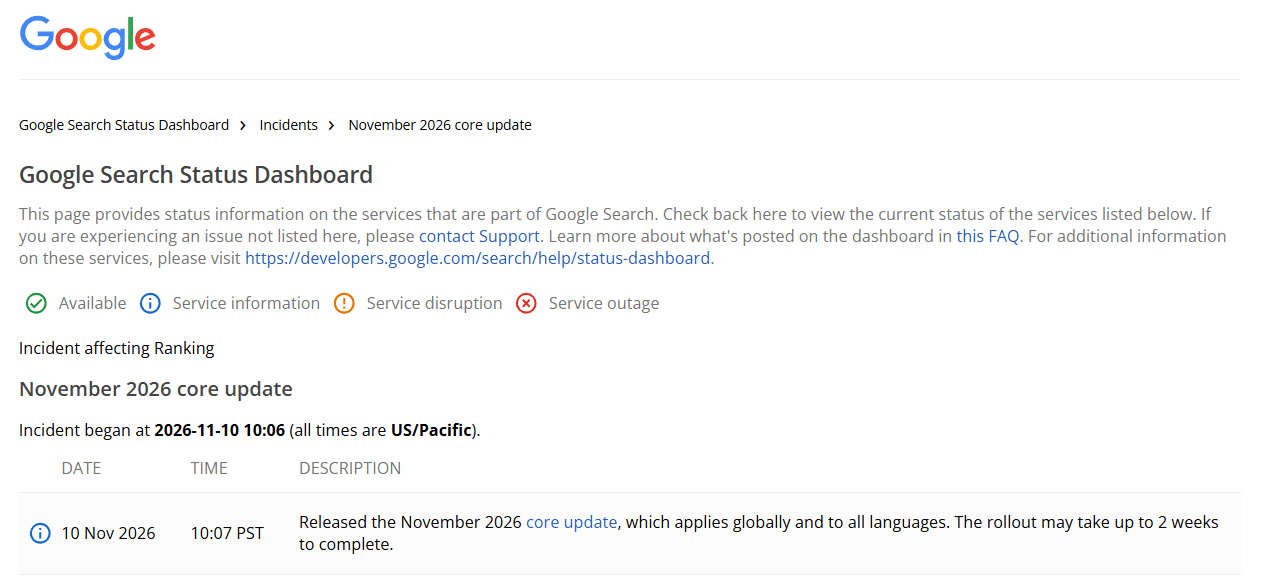
Google started the rollout on November 10 at 10:06 a.m. Pacific time, according to the Google Search Status Dashboard. The dashboard entry says the update applies globally and to all languages and may take up to two weeks. In its LinkedIn announcement, Google Search Central called it a regular update meant to surface relevant, satisfying content for searchers from all types of sites.
This is the third broad core update of 2026. The March update ran from March 27 to April 8, and the May update from May 21 to June 2. You can see every past release on Google's ranking update history. If November's rollout uses its full window, it will end around November 24, three days before Black Friday, and the first clean week of post-update data won't exist until about December 1.
What Google changed in its content guidance in October
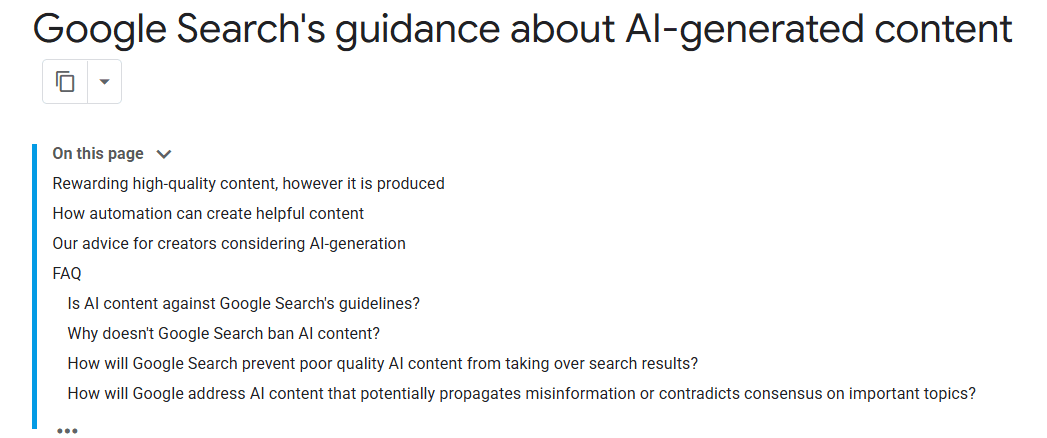
On October 1, 2026, Google updated its guidance on using generative AI content. Three sentences were added to the section on accuracy, quality and relevance. They explain that generative models predict a likely sequence of words instead of looking up facts, so their output can include hallucinations, and they state that manually fact-checking and reviewing all AI-generated content before publishing is critical. Google's changelog says the edit brought the guide in line with its Search Quality Rater Guidelines.
The review also covers metadata: page titles, meta descriptions, structured data and image alt text. Many content workflows generate those fields automatically and never show them to an editor.
The update did not add a penalty for AI-assisted content. Google's position is still that it judges content on quality and helpfulness, however it was produced. Its guide to creating helpful, reliable, people-first content remains the best self-assessment checklist, and its guide to optimizing for generative AI search, published in May 2026, makes the same case for AI Overviews and AI Mode: good SEO for AI features is still good SEO.
Why you shouldn't make changes in a hurry
When traffic drops during a core update, the instinct is to rewrite pages, delete old posts or change titles straight away. Google's own guidance on core updates argues against that, for reasons that hold up in practice.
A core update is not a penalty. Google says pages can lose rankings without breaking any rule, because the update reassesses content across the whole web and other pages may simply have been judged more relevant. A drop tells you something changed, but it won't tell you what, if anything, is wrong with your page.
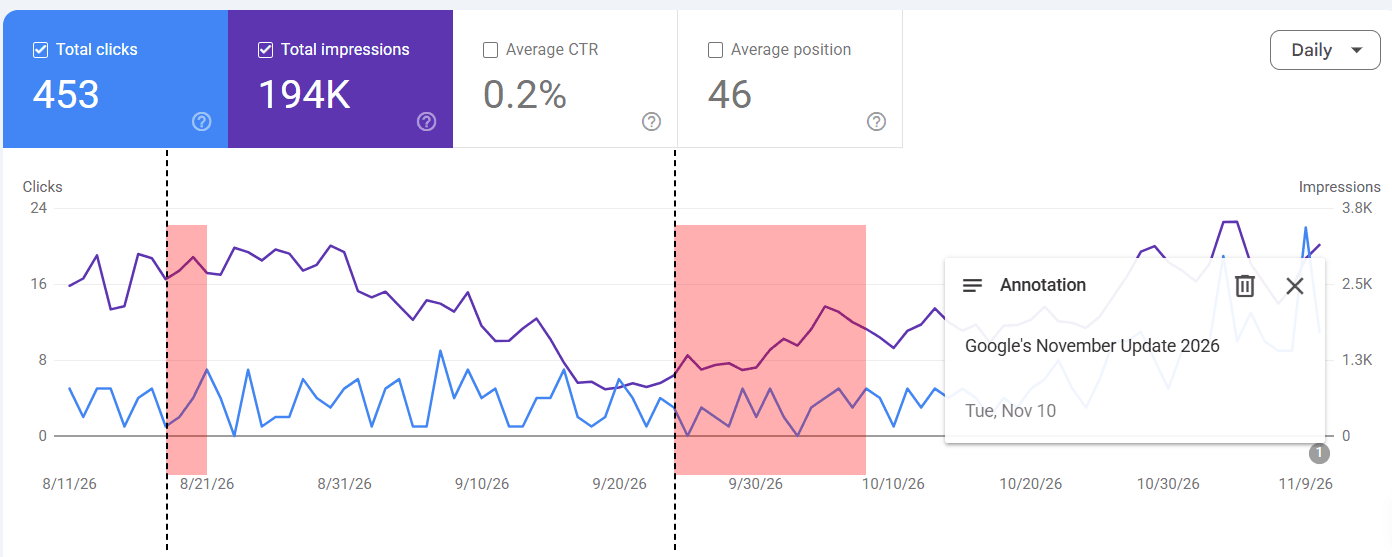
Rankings also move up and down while the rollout is in progress, so any edit you make now gets tangled with the update's own movement, and you lose the ability to tell which caused what. Google recommends waiting at least a full week after the rollout is complete, then comparing that week's Search Console data with a week from before the rollout began. For this update, that means comparing a week starting after November 24 (or whenever Google marks it complete) with the week before November 10.
Holiday seasonality makes this harder. Black Friday, Cyber Monday and Thanksgiving week will all fall inside the first full week of post-update data, so a retailer may see traffic jump for reasons that have nothing to do with the update, and a B2B site may see it dip as buyers go on holiday. Compare against the same weeks of last year as well as the week before the rollout.
Search Console data can also lag. In October 2026 the Performance report fell more than 60 hours behind for many sites before catching up the next day. Before reacting to a drop, check the report's last-updated time.
Here is what to do while you wait. Add an annotation for November 10 in Search Console and your analytics tools so the date is marked on every future chart. Export your top pages and queries now as a baseline. Keep publishing as planned, but hold back site-wide changes such as mass rewrites, deletions, redirects or template changes until the data settles. If you need a structured way to investigate once it does, Google's guide to debugging search traffic drops is the place to start.
Guidelines that apply to every industry
Before getting into sector-specific checks, a few rules apply to everyone.
Write for the person searching. Google's helpful content guidance asks whether a reader would leave feeling they learned enough to reach their goal, and whether the content shows first-hand experience or real expertise. Pages built mainly to capture search traffic tend to fail that test.
Show who made the content and how. Google's guidance suggests being clear about who wrote a page, how it was produced (including whether automation or AI was used) and why it exists. Real author names, credentials and a short note on how you researched or tested something all help readers judge whether to trust you. The Search Quality Rater Guidelines explain how Google's human raters assess experience, expertise, authoritativeness and trust, and they are worth reading in full if you publish in a regulated field.
Fact-check everything a reader or a machine will see. Since October that explicitly includes titles, descriptions, schema and alt text. Assign someone to review generated metadata the same way an editor reviews copy.
Don't publish pages at scale just because you can. Google's spam policies define scaled content abuse as producing many pages mainly to manipulate rankings rather than help users, whether people or AI produce them. Hundreds of near-identical location or comparison pages are the classic example.
Keep structured data in step with the page. Prices, availability, ratings and dates in your markup must match what visitors see. Google's Search Essentials cover the technical baseline.
Our guide to building a content strategy in 2026 shows how to build these checks into a publishing workflow.
What each industry should check before publishing
Logistics and supply chain
Logistics content goes stale quickly. Transit times, fuel surcharges, port congestion, customs rules and carrier rates can change within weeks, and a page that quotes last quarter's numbers misleads the shippers you want to win. Put a "last reviewed" date on pages that cite rates or regulations, and give them an owner who updates them.
Be careful with programmatic city and lane pages such as "freight shipping from Chicago to Dallas." They can be useful when each page carries real information for that route, like typical transit times, equipment options or lane-specific restrictions. When only the city names change, they look like scaled content. Content written or reviewed by people with operations experience, and original data from your own shipments, will set you apart from competitors who publish the same generic explainers.
Ecommerce and retail
With Black Friday falling right after the rollout window, the main rule for online stores is not to overhaul category or product page templates mid-update. Fix clear errors, but leave major rewrites until you can measure them.
Write your own product descriptions. Manufacturer copy usually appears word for word on dozens of other sites. Make sure your product structured data carries current prices and stock levels, especially when holiday promotions change prices daily. Google also lets you set shipping and return policies directly in Search Console, which helps your listings show accurate delivery and returns information. Google's ecommerce guidance covers site structure and product data in more depth. If your store sells gifts, our research on which brands AI recommends for holiday gifts shows how the same product signals affect AI answers.
Healthcare
Health content is what Google's rater guidelines call "Your Money or Your Life" content, where inaccurate information can cause real harm, so it is held to the highest standard of trust. Every clinical claim should be reviewed by a qualified professional who is named on the page with their credentials and the date of review.
The October guidance matters most here. AI tools can produce confident, plausible text about dosages, symptoms or treatments that is simply wrong. No AI-drafted health content should go live without clinical review, and that includes the meta description that appears in search results. Cite primary sources such as clinical guidelines and peer-reviewed studies, and update pages when guidance changes.
Fashion and beauty
Fashion and beauty brands live on visual search. Shoppers now search with Google Lens and Circle to Search, so original product photography is a ranking asset, while stock images or the supplier's photos add little. Google's image SEO guidance covers file names, placement and alt text.
Alt text now sits inside the fact-check scope too. AI-generated alt text often gets colors, materials or product names wrong, which misleads both visually impaired shoppers and search engines. Useful sizing, fit and fabric details from people who have handled the product do more than another generic "top 10 trends" listicle.
Technology and SaaS
Technology readers notice errors quickly. Comparisons and reviews should be based on hands-on testing, and the page should say what you tested, on which version and when. Software changes often, so date your content and update it when features or pricing change.
If your team uses AI to draft tutorials or documentation, run every code sample and command before publishing. A snippet that doesn't work damages trust faster than any ranking change. Avoid unverifiable claims about competitors, and link to the official documentation you relied on.
Financial services
Like healthcare, finance is YMYL content. Interest rates, fees, tax thresholds and regulations should be dated, sourced and reviewed by someone qualified, with their credentials shown. Include the disclosures your regulator requires, and make clear when content is general information rather than personal advice. AI-generated figures, such as an example loan calculation or a tax limit, need checking against the official source every time.
Travel, hospitality and local businesses
Travel and local pages are judged heavily on first-hand experience and current details. Opening hours, prices, seasonal closures and booking policies need to be accurate, and your website should agree with your Google Business Profile and directory listings. Write about places your team has actually visited or services you actually provide, and never publish fake or incentivized reviews. If you run multiple locations, give each location page specific information, such as its team, services, parking or nearby landmarks, rather than swapping the town name.
Need a second pair of eyes before you publish? Lean Summits reviews content and technical setups against Google's guidelines for logistics, ecommerce, healthcare, technology and consumer brands. Book a free strategy call and we'll tell you what to fix now and what can wait until the update settles.
What to do once the rollout is complete
When Google marks the update as complete on the Status Dashboard, wait a full week, then compare that week with the week before November 10 in Search Console. Look at which pages and query groups moved as well as the sitewide total. If a group of pages dropped, read them against Google's helpful content questions and ask honestly whether a competitor's page now answers the query better.
Improvements made after a core update can take time to show. Google says some changes may not be reflected until its systems reassess the site, which sometimes means the next core update. That is one more reason to make a few careful improvements rather than many rushed ones. Our technical SEO and AI search audit and our breakdown of the new Google Search Console reports in 2026 can help with the analysis.
Want a calm, data-led read on how the update affected you? Our SEO and Generative Engine Optimization team will compare your before-and-after data, separate the update's impact from holiday seasonality, and give you a prioritized plan. Talk to Lean Summits.
Frequently asked questions
When did the November 2026 core update start?
Google began rolling it out on November 10, 2026, at 10:06 a.m. Pacific time. It applies globally and in all languages, and Google said the rollout may take up to two weeks.
Is a core update a penalty?
No. Core updates reassess how relevant and helpful content is across the web. Pages can lose rankings without violating any of Google's policies, often because other pages are now judged more useful for the same queries.
Should I change my content during the rollout?
Keep publishing as planned, but avoid large site-wide changes until the rollout has finished and you have a full week of data afterward. Changes made mid-rollout are hard to measure because rankings are already moving.
Does Google penalize AI-generated content?
Google says it judges content on quality and helpfulness, however it was made. Its October 2026 guidance adds that AI-generated content, including titles, meta descriptions, structured data and alt text, should be fact-checked and reviewed by a person before publishing.
How do I measure the impact of the core update?
Wait at least one full week after Google marks the rollout complete, then compare that week with a week before November 10 in Search Console. Because the post-update week overlaps Black Friday and Cyber Monday, compare against the same period last year as well.
Google's official resources
- Google Search's core updates
- Creating helpful, reliable, people-first content
- Google Search's guidance on using generative AI content
- Optimizing for generative AI features on Google Search
- Spam policies for Google web search
- Search Quality Rater Guidelines
- Debugging drops in Google Search traffic
- Google Search Status Dashboard
- Google Search documentation updates
About the author
Shraddhanvita Tiwari is the Content Strategist and SEO Lead at Lean Summits, where she builds search and AI visibility content programs for B2B and B2C brands. This article was reviewed for accuracy by Ravi Adatrao, Marketing Strategist and President of Lean Summits.
 Shraddha