
- Key Takeaways
- How We Compiled This List
- The 100 Most Asked Questions on Google in 2026
- Date and Time Questions
- Holiday and Event Questions
- Conversion and Quick Math Questions
- Technology and Device Questions
- AI and Learning-to-Code Questions
- Money, Work and Business Questions
- Health and Wellbeing Questions
- Everyday How-To Questions
- General Knowledge and Language Questions
- What These 100 Questions Tell Us About Search in 2026
- 1. Over a third of top questions never need a click
- 2. Year-bound questions reward pages that are updated, not replaced
- 3. AI questions are small in volume but growing fast
- 4. Questions are getting longer and more conversational
- The Real Question for Brands: Who Gets Cited in the Answer?
- Step 1: See where your brand stands across AI engines
- Step 2: Turn every missed citation into a content brief
- How to Find the Most Asked Questions in Your Own Industry
- 1. Start with your customers, not tools
- 2. Expand with Google's own question data
- 3. Score which questions are worth targeting
- 4. Test the same questions in AI engines
- How to Answer Questions So Google and AI Engines Cite You
- Build an AI Growth Strategy Around the Questions Your Buyers Ask
- Frequently Asked Questions
- What is the most asked question on Google in 2026?
- Why do search volume numbers differ between SEO tools?
- Should my business create content for the most asked questions on Google?
- How do I know if AI engines like ChatGPT mention my brand?
- What is the difference between SEO and GEO?
- Sources
- About the Author
Featured Posts
100 Most Asked Questions on Google in 2026 (What AI Search Is Doing With Them)
By Shraddha
published October 4, 2026

By Shraddhanvita Tiwari, Content Strategist and SEO Lead | Reviewed by Ravi Adatrao, Marketing Strategist and President | Last updated: October 5, 2026
Key Takeaways
- More than a third of the most asked questions on Google in 2026 are quick-answer utility queries: dates, times, unit conversions and holiday lookups.
- Search volume estimates for the same question vary by several million between tools, so treat any single number as directional, not exact.
- AI questions such as "what is AI" and "how to use ChatGPT" are now in the top 100, which shows how fast AI has moved into everyday search behavior.
- For businesses, the bigger opportunity is not the global top 100. It is the questions buyers in your category ask Google and AI engines, and whether those engines cite you in the answer.
- Tools like GeoPulse show how ChatGPT, Claude, Gemini and Google AI Overviews answer your category's questions, and which competitors they recommend instead of you.
Every day, billions of people type questions into Google. Some want the date. Some want to fix a flat tire. Some want to understand artificial intelligence. Put together, the most asked questions on Google are one of the clearest pictures we have of what people actually need from the internet.
For marketers, these questions are more than trivia. They show how search intent is changing, which queries Google now answers without a click, and where AI engines are taking over the job of answering. In this guide, we share the 100 most asked questions on Google in 2026, the patterns behind them, and how to find and win the questions that matter in your own market.
How We Compiled This List
No single tool has the "true" search volume for a question. Google does not publish exact query counts, and every SEO platform models its numbers differently. To reduce the bias of any one source, we cross-referenced several public 2026 datasets, including research from Semrush, Exploding Topics and Glimpse, alongside Google Keyword Planner checks.
We kept questions that appeared consistently near the top across sources, removed near-duplicates (for example, "when is mothers day" and "when is mother's day"), and excluded queries tied to breaking news or tragedies. We then grouped the remaining 100 questions by intent, because intent tells you far more about strategy than rank order does.
The variance between tools is worth noting. Exploding Topics estimates "what is today" at about 16.2 million global monthly searches, while other 2026 datasets place it between roughly 5 million and 13.6 million. The same gap shows up for "what is AI," with estimates ranging from around 560,000 to more than 2 million. The order is fairly stable across tools. The exact numbers are not.
The 100 Most Asked Questions on Google in 2026
Date and Time Questions
The single most common reason people ask Google a question is to orient themselves in time.
- What is today?
- What time is it?
- What day is it?
- What is today's date?
- What year is it?
- What holiday is today?
- When does the time change?
- When is daylight savings 2026?
- What time is sunset?
- How many days until Christmas?
Holiday and Event Questions
Calendar questions spike every year and are often tied to a specific year, which makes them highly seasonal.
- When is Easter 2026?
- When is Mother's Day?
- When is Father's Day?
- When is Thanksgiving?
- When is Halloween?
- When is Black Friday?
- When is Labor Day?
- When is Valentine's Day?
- When is Chinese New Year 2026?
- When is Diwali?
- When is the next full moon?
- When is the Super Bowl 2026?
Conversion and Quick Math Questions
Google has quietly become the world's most-used calculator, especially for kitchen and distance conversions.
- How many ounces in a cup?
- How many ounces in a pound?
- How many ounces in a gallon?
- How many cups in a quart?
- How many quarts in a gallon?
- How many teaspoons in a tablespoon?
- How many tablespoons in a cup?
- How many grams in an ounce?
- How many liters in a gallon?
- How many feet in a mile?
- How many steps in a mile?
- How many weeks in a year?
- How many seconds in a day?
- How old am I?
Technology and Device Questions
Device help is a constant: screenshots, accounts, privacy and "who is calling me" lookups.
- What is my IP?
- How to find IP address?
- How to screenshot on Mac?
- How to screenshot on Windows?
- How to screenshot on Chromebook?
- How to take a screenshot?
- How to clear cache?
- How to delete Instagram account?
- How to delete Facebook account?
- How to delete Twitter account?
- How to delete TikTok account?
- How to download YouTube videos?
- Who called me?
- Who called me from this phone number?
- Where am I?
- What song is this?
AI and Learning-to-Code Questions
This is the fastest-moving group. A few years ago, none of these AI questions were close to the top 100.
- What is AI?
- How to use ChatGPT?
- How to use AI?
- What is Grok?
- What is Sora?
- What is Meta?
- What is Python?
- What is SQL?
- How to learn JavaScript?
Money, Work and Business Questions
Personal finance and side-income questions carry real commercial intent, which makes them valuable for brands.
- Where's my refund?
- How to make a budget?
- How to create invoices?
- How to write a check?
- How much house can I afford?
- How to start a business?
- How to make money online?
- How to make money fast?
- How to start a blog?
- How to make a website?
- What is GDP?
Health and Wellbeing Questions
Health questions fall under Google's "Your Money or Your Life" standards, so expertise and trust signals matter most here.
- How to lose weight fast?
- How to lose weight?
- How to lower blood pressure?
- How to get rid of hiccups?
- How to relax?
- How to meditate?
- How to be happy?
- Why does my stomach hurt?
- What causes kidney stones?
Everyday How-To Questions
Practical, hands-on tasks that people want solved quickly, often with a video.
- How to change a tire?
- How to change oil?
- How to tie a tie?
- How long to boil eggs?
- How to cook rice?
- How to draw?
- How to pronounce [word]?
- What time does McDonald's stop serving breakfast?
- What to watch?
General Knowledge and Language Questions
Curiosity, school help and internet slang round out the list.
- What is a verb?
- What is a noun?
- What is love?
- What is climate change?
- How many people are in the world?
- How many countries are there in the world?
- Who is the richest person in the world?
- Why is the sky blue?
- What does SMH mean?
- What does 6 7 mean?
What These 100 Questions Tell Us About Search in 2026
1. Over a third of top questions never need a click
In our list, 36 of the 100 questions are date, time, holiday or conversion lookups. Google answers nearly all of them directly on the results page through instant answers, knowledge panels and AI Overviews. For publishers, ranking for these queries brings brand exposure but very little traffic. We cover this shift in detail in our guide to zero-click searches and AI Overviews, and in why brand recall now matters more in zero-click search.
2. Year-bound questions reward pages that are updated, not replaced
Questions like "when is Easter 2026" lose almost all their volume once the date passes, then return under a new year the next season. The smarter approach is to keep one evergreen URL and refresh the year, dates and details annually. That way the page keeps its history and links instead of starting from zero each year.
3. AI questions are small in volume but growing fast
Nine of the 100 questions are about AI tools or technical skills. Their volumes are still far below "what is today," but their presence in the top 100 is the signal. People are actively learning how to use AI, which means more of them will soon be asking AI engines their questions directly instead of Google.
4. Questions are getting longer and more conversational
Short head terms dominate this list, but the long tail is changing. Buyers increasingly phrase searches as full questions, the same way they talk to ChatGPT or Gemini. We explored this trend in From Keywords to Questions: How Search Is Becoming More Conversational in 2026.
Want to know which questions your buyers are asking right now? Lean Summits builds AI growth strategies that connect search demand, AI visibility and pipeline. Book a free strategy call and we will map the highest-value questions in your category.
The Real Question for Brands: Who Gets Cited in the Answer?
A global top 100 list is useful for understanding behavior, but it rarely drives revenue on its own. A freight broker does not need to rank for "how many ounces in a cup." It needs to show up when a logistics manager asks, "Which freight forwarders handle EU customs for mid-size shippers?" More and more, that question is answered by an AI engine, not a list of blue links.
That is why we built GeoPulse, the AI visibility agent inside Lean Summits' Orbit platform. GeoPulse runs your category's questions across ChatGPT, Claude, Gemini and Google AI Overviews, then shows where your brand is cited, missing or misrepresented, and which competitors are recommended in your place.
Step 1: See where your brand stands across AI engines
You start by entering your domain, keyword set, competitors and target market. GeoPulse then queries each AI engine across your full set of prompts and returns a single readout with your visibility score, citation share and competitor gap.
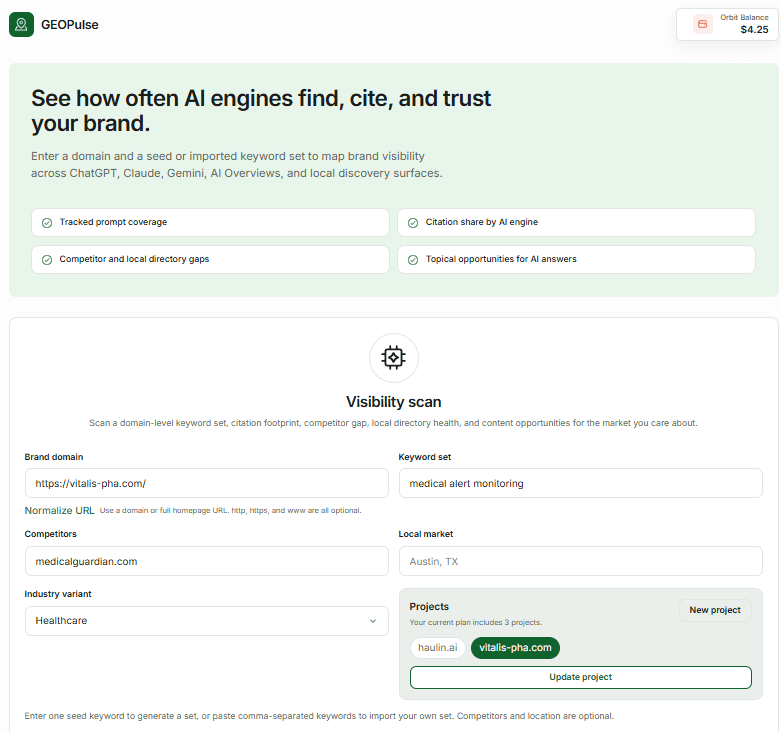
This view answers the question that a traditional rank tracker cannot: when a buyer asks an AI engine about your category, does your brand appear at all? It is the AI-search equivalent of checking your Google rankings, and for many B2B companies it reveals blind spots they did not know existed.
Step 2: Turn every missed citation into a content brief
Visibility data only helps if it leads to action. For every question where a competitor is cited and you are not, GeoPulse creates a prioritized content brief mapped to the exact AI queries you are losing. Your writers can pick it up immediately, and recurring scans track whether the new content changes how AI engines respond.
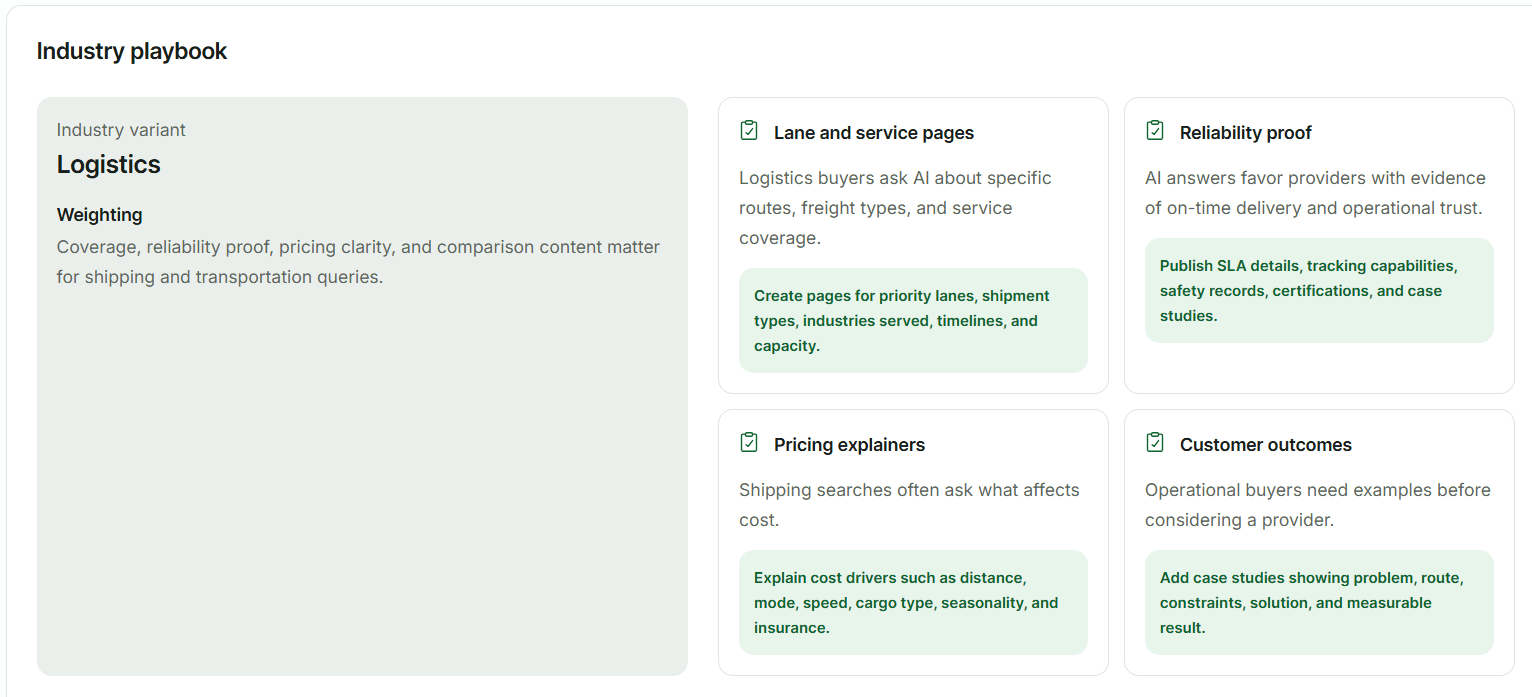
If you are new to this discipline, start with our beginner's guide to GEO, AEO and LLMO, then read whether AI visibility actually drives traffic and leads.
How to Find the Most Asked Questions in Your Own Industry
The method below is the same process our SEO team uses when building content strategies for clients in SaaS, logistics, healthcare and manufacturing.
1. Start with your customers, not tools
Pull the questions your sales team hears on calls, the questions in support tickets and the questions prospects type into your site search. These are the most valuable questions you have, because they come from real buyers. Our article on the B2B buyer journey in 2026 explains where these questions show up at each stage.
2. Expand with Google's own question data
Type a question stem ("how to," "what is," "best") plus your category into Google and note the autocomplete suggestions. Then open the People Also Ask box and expand it a few levels. Finally, filter Google Search Console by queries containing question words to see which ones already bring you impressions.
3. Score which questions are worth targeting
Not every question deserves a page. Use Rank My Term to score a keyword's ranking difficulty against current competitors, and remove queries that Google already answers instantly on the results page.
4. Test the same questions in AI engines
Rephrase your top questions the way a buyer would ask an AI assistant: longer, more specific and comparison-driven. Run them through GeoPulse to see which brands and sources each engine cites. Where you are absent, you have found your next content priority.
How to Answer Questions So Google and AI Engines Cite You
Finding the right questions is half the work. The other half is answering them in a way that search engines and AI models trust.
- Answer first, explain second. Put a clear, direct answer in the first two sentences under each question heading, then add depth. AI engines tend to pull concise, self-contained answers.
- Use the question as the heading. Match the buyer's wording in your H2 or H3 so both Google and AI models can map your content to the query.
- Show real expertise. Add named authors with credentials, first-hand data, client examples and clear sourcing. This is the core of Google's E-E-A-T guidelines and a strong trust signal for AI engines.
- Cite quality sources. AI engines are getting better at judging source quality. Our piece on citation laundering and AI search source quality explains why weak sources now hurt you.
- Fix the technical basics. Structured data, crawlable pages and fast load times help both Google and AI crawlers. Use our technical SEO and AI search audit as a checklist.
- Keep content fresh. Review your top question pages at least every quarter, especially for anything with dates, prices or statistics.
For a step-by-step approach, read How to Get AI Search Engines to Cite Your Brand and our Google AI Overviews SEO strategy. You can also download our free SEO Strategy Template to connect questions with funnel stages and conversion paths.
Build an AI Growth Strategy Around the Questions Your Buyers Ask
Ranking for questions is no longer only an SEO task. It touches content, technical SEO, brand authority and measurement across both Google and AI engines. Lean Summits combines SEO and Generative Engine Optimization with AI agents like GeoPulse so your team can see, fix and track visibility in one system. See how this has worked for others in our AI traffic growth case study and our full list of client case studies.
Ready to become the answer AI recommends? Book a 30-minute strategy call with Lean Summits. We will review your current AI visibility, identify the questions you are losing to competitors, and recommend the fastest path to more qualified pipeline.
Frequently Asked Questions
What is the most asked question on Google in 2026?
"What is today" is the most asked question on Google globally in 2026 across most major datasets, with estimates ranging from about 5 million to over 16 million monthly searches depending on the tool. "What is my IP" and "what time is it" are consistently close behind.
Why do search volume numbers differ between SEO tools?
Google does not publish exact search counts. Each tool estimates volume using its own clickstream data, sampling and models, and Google Keyword Planner groups close variants into ranges. Use any volume figure as a directional guide and compare trends rather than exact numbers.
Should my business create content for the most asked questions on Google?
Usually not for the global top 100, since most are answered directly on Google and unrelated to your buyers. Focus instead on the most asked questions in your own industry, especially ones with commercial intent where your expertise gives you an advantage.
How do I know if AI engines like ChatGPT mention my brand?
You can test prompts manually, but results change often and vary by engine. A tool like GeoPulse runs your full prompt set across ChatGPT, Claude, Gemini and Google AI Overviews, tracks your citation share over time and alerts you when competitors gain ground.
What is the difference between SEO and GEO?
SEO helps your pages rank in traditional search results. GEO (Generative Engine Optimization) helps your brand get cited and recommended inside AI-generated answers. In 2026, most businesses need both, because buyers move between Google and AI assistants during the same research journey.
Sources
- Semrush: The Most Searched Things on Google (2026)
- Google Search Central: Creating helpful, reliable, people-first content
About the Author
Shraddhanvita Tiwari is the Content Strategist and SEO Lead at Lean Summits, where she builds search and AI visibility content programs for B2B and B2C brands. This article was reviewed for accuracy by Ravi Adatrao, Marketing Strategist and President of Lean Summits.
 Shraddha