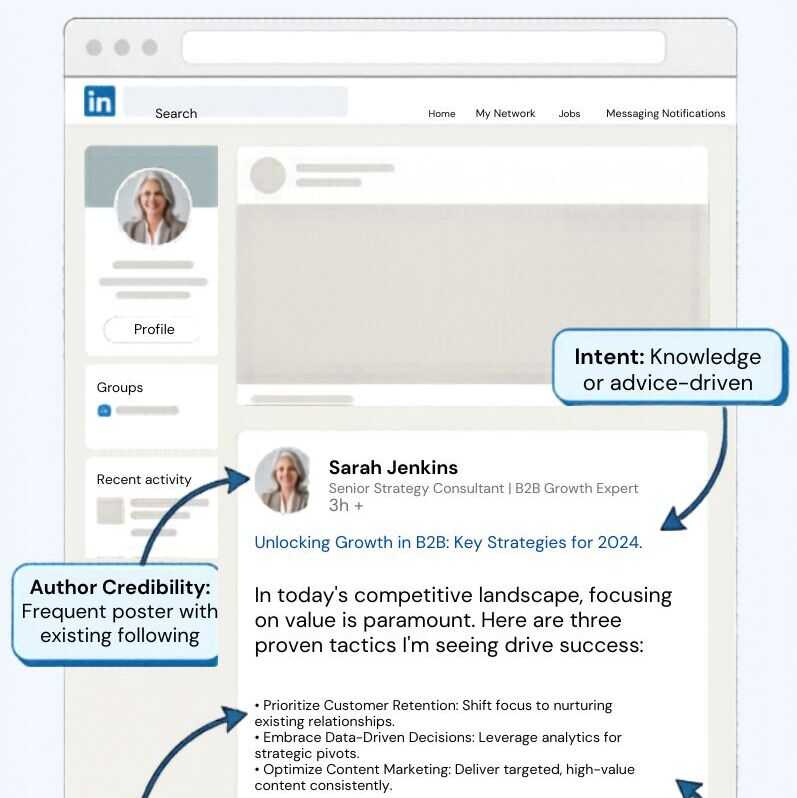
AI systems now prioritize LinkedIn content when answering business queries, making it critical for companies to publish clear, educational, and experience-based posts. This guide shows how businesses across logistics, SaaS, eCommerce, and IT can structure LinkedIn content to build topical authority, earn AI citations, and drive sustainable growth—without chasing viral metrics.
The landscape of business visibility has fundamentally changed. As Semrush’s recent study on AI visibility reveals, artificial intelligence systems are actively indexing and citing LinkedIn content when responding to user queries. For businesses across all industries, this represents a significant shift in how potential customers discover solutions, evaluate expertise, and choose partners.
The implication is clear: LinkedIn is no longer just a networking platform. It has become a knowledge repository that AI systems trust and reference. Companies that understand how to structure their content for this new reality will gain a measurable advantage in market visibility and credibility.
Understanding the AI Visibility Shift
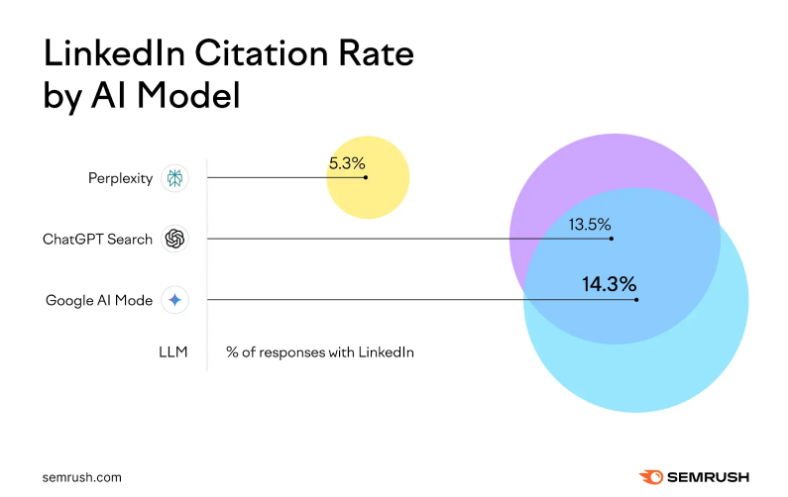
According to the Semrush study, LinkedIn ranks among the most frequently cited sources across major AI platforms including ChatGPT, Claude, and Perplexity. This is not coincidental. LinkedIn’s professional focus, verified user base, and emphasis on original expertise make it inherently trustworthy to AI systems trained to identify authoritative sources.
What makes this significant is that AI does not simply count links or impressions. These systems analyze meaning, clarity, and utility. When someone asks an AI assistant about supply chain optimization, vendor management strategies, or SaaS implementation best practices, the AI draws from content that clearly addresses these topics with depth and practical insight.
For businesses, this creates an opportunity that traditional SEO alone cannot capture. While your website might rank for specific keywords, your LinkedIn content can position your organization as the trusted voice AI systems reference when explaining complex concepts in your industry.
Why Traditional Metrics No Longer Tell the Full Story
The research reveals something counterintuitive: moderate engagement can be sufficient for AI visibility if the content genuinely answers real questions. A post with two hundred likes that clearly explains a logistics challenge and solution may earn more AI citations than a viral post with ten thousand reactions but shallow insights.
This fundamentally changes content strategy. The goal shifts from maximizing likes and shares to maximizing clarity, usefulness, and topical relevance. AI systems reward substance over virality because they are optimizing for accuracy and helpfulness, not entertainment.
For companies competing in crowded markets, this levels the playing field. You do not need millions of followers or a celebrity executive to build AI visibility. You need consistent expertise, clear communication, and a commitment to sharing genuine knowledge.
Structuring LinkedIn Content for Maximum AI Visibility
Start with Clear Problem-Solution Frameworks
AI systems excel at pattern recognition. When your content follows a recognizable structure—identify a problem, explain context, offer a solution—AI can more easily extract and repurpose that information.
For example, a logistics company might structure a post like this:
Problem: Freight costs increased thirty percent year-over-year due to capacity shortages.
Context: Mid-sized shippers without dedicated contracts faced the highest exposure.
Solution: We implemented a hybrid procurement model combining spot market flexibility with strategic lane partnerships, reducing overall costs by eighteen percent while maintaining service levels.
This structure makes it easy for AI to understand the scenario, extract the key insight, and reference it when someone asks about freight cost management strategies.
Lead with Your Unique Perspective
The Semrush study emphasizes that original content consistently outperforms reshares. AI systems can detect when content adds new insights versus merely amplifying existing narratives.
For eCommerce businesses, this means sharing actual data from your operations. Instead of posting generic advice about conversion rate optimization, share what you learned when testing checkout flows across five thousand transactions. Specify what worked, what failed, and why.
For IT service providers, this means documenting real implementation challenges. When you migrate a client from legacy infrastructure to cloud-native architecture, write about the unexpected obstacles, the decision points that mattered, and the outcomes you measured.
Specificity signals expertise. AI systems prioritize content that demonstrates firsthand knowledge over content that repackages common wisdom.
Answer Questions Your Customers Actually Ask
The most cited content addresses real questions that people ask AI assistants. To identify these questions in your industry, pay attention to:
- Sales calls where prospects ask for clarification on concepts
- Customer support tickets that reveal knowledge gaps
- Conference Q&A sessions that expose common misconceptions
- Industry forums where professionals seek advice
A SaaS company selling project management tools might notice customers frequently ask about integrating multiple tools without creating duplicate work. A LinkedIn post explaining your framework for tool consolidation, with specific examples of integration architectures that worked, directly addresses a question people ask AI systems daily.
When your content answers these questions clearly and thoroughly, AI systems recognize it as valuable reference material.
Use Consistent Terminology and Semantic Clarity
AI visibility depends on semantic clarity. Use industry-standard terminology consistently, but also define terms when necessary. This helps AI systems understand context and accurately represent your expertise.
For instance, if you are a supply chain consultant discussing “just-in-time” versus “just-in-case” inventory strategies, explicitly state what each term means in your context before diving into comparative analysis. This semantic scaffolding helps AI extract accurate information.
Avoid jargon for its own sake, but do not oversimplify technical concepts. AI systems are sophisticated enough to handle nuance when that nuance is clearly explained.
Build Topical Authority Through Content Clusters
The research shows that consistency and expertise matter more than follower count. One effective approach is publishing content clusters around core topics.
A logistics company might create a content series on warehouse optimization:
- Post one: Layout design principles for high-velocity SKUs
- Post two: Technology stack decisions for warehouse management systems
- Post three: Labor scheduling strategies during peak seasons
- Post four: KPIs that actually predict operational bottlenecks
This cluster approach signals depth of expertise. When AI systems see multiple well-structured posts on related subtopics from the same source, they identify that source as authoritative on the broader topic.
Incorporate Data and Measurable Outcomes
Educational content drives AI citations, but educational content backed by data drives even more. Whenever possible, include specific metrics, timeframes, and measurable results.
Instead of: “We improved customer retention.”
Write: “We increased ninety-day retention from sixty-two percent to seventy-eight percent by implementing a proactive outreach cadence at days fourteen and forty-five post-purchase.”
This specificity accomplishes two things. First, it makes your content more credible and useful to human readers. Second, it gives AI systems concrete information to reference when answering questions about customer retention strategies.
Industry-Specific Applications
For Logistics and Supply Chain Companies
Focus your LinkedIn content on operational challenges and solutions. Document how you navigated port congestion, optimized last-mile delivery in rural areas, or reduced detention times through better scheduling. Share the framework, the implementation process, and the measurable impact.
AI systems frequently field questions about supply chain resilience, cost optimization, and service level management. Your firsthand experience addressing these challenges positions you as a reference source.
For SaaS and Technology Firms
Publish content about implementation methodologies, integration patterns, and adoption strategies. Avoid product pitches. Instead, explain how you solve category-level problems.
A marketing automation SaaS might write about lead scoring frameworks, explaining the difference between demographic and behavioral scoring, when each approach works best, and how to avoid common pitfalls. This positions the company as an expert in marketing operations, not just a vendor.
For eCommerce Businesses
Share insights on customer behavior, conversion optimization, fulfillment strategies, and market trends. Use your data to illuminate patterns that others might miss.
For example, analyze how your conversion rates vary by traffic source, device type, and time of day. Explain what you learned and how it changed your marketing allocation. This type of analysis-driven content earns AI citations because it provides specific, actionable insights.
For IT Services and Consulting
Document your methodologies, frameworks, and decision-making processes. When you complete a complex migration, security implementation, or system integration, write about the approach you took and why.
Focus on the “how” and “why” rather than just the “what.” AI systems value content that helps people understand not just what was done, but the reasoning and trade-offs involved.
Creating a Sustainable Content Practice
The Semrush research makes clear that consistency matters. Sporadic posting, regardless of quality, does not build the topical authority that drives AI visibility. The companies earning the most AI citations publish regularly and maintain focus on their core expertise areas.
This does not require daily posting. It requires commitment to a cadence you can sustain—whether that is twice weekly, weekly, or biweekly—and discipline to maintain quality.
Develop a Content Bank
Build a repository of topics drawn from:
- Client questions and challenges
- Internal training materials
- Project retrospectives
- Industry developments you have unique perspective on
This ensures you always have relevant material to draw from and prevents content creation from becoming reactive or rushed.
Involve Multiple Voices
The research indicates both company pages and individual creators influence AI visibility. Encourage subject matter experts within your organization to share their knowledge on LinkedIn.
A VP of Operations writing about warehouse efficiency, a Customer Success Manager explaining onboarding best practices, and a Product Lead discussing feature prioritization frameworks all contribute to your organization’s topical authority.
Measure What Matters
Traditional engagement metrics—likes, comments, shares—matter for understanding what resonates with your human audience. But for AI visibility, focus on:
- Clarity of your core messages
- Consistency of your publishing cadence
- Depth of coverage on key topics
- Specificity and originality of insights
You cannot directly measure AI citations in real-time, but you can measure the inputs that drive them.
The Competitive Advantage of Educational Content
Companies that embrace this shift gain multiple advantages. First, your content becomes a persistent visibility asset. Unlike paid advertising that disappears when the budget runs out, quality educational content continues earning AI citations indefinitely.
Second, you attract better-qualified prospects. When someone discovers your company through AI-cited content that addressed their specific question, they arrive already educated about your approach and expertise. This dramatically shortens sales cycles.
Third, you build defensible differentiation. Competitors can copy your pricing, replicate your features, and hire similar talent. They cannot easily replicate years of published expertise that AI systems already recognize and cite.
Moving Forward
AI visibility through LinkedIn is not about gaming algorithms or chasing shortcuts. It is about committing to publish clear, original, and consistently useful content that genuinely helps your audience solve problems and make better decisions.
The companies that will dominate AI visibility are those that view content creation as an investment in long-term authority, not a short-term marketing tactic. They understand that every well-structured post explaining a concept, sharing a framework, or documenting a solution becomes a reference point that AI systems can draw upon for years.
Start by auditing your existing LinkedIn presence. Identify the core topics where your organization has genuine expertise. Develop a sustainable publishing cadence. Focus on clarity, specificity, and educational value. The AI visibility will follow.
The shift is already happening. The question is whether your organization will lead it or react to it.
Ready to build a content strategy that drives real business growth? Lean Summits helps organizations across all industries develop sustainable processes for excellence and visibility. Whether you’re optimizing operations, building team capabilities, or establishing thought leadership, we bring proven methodologies and practical expertise. Connect with us today to explore how we can support your growth objectives.